Mustard Cake (Sarson Khal) in Cattle Feed
By Parv Badjatiya · Published Mon May 18 2026 00:00:00 GMT+0000 (Coordinated Universal Time) · Updated Mon May 18 2026 00:00:00 GMT+0000 (Coordinated Universal Time)
What is mustard cake?
Mustard cake — known in India as sarson khal — is the protein-rich, oil-bearing residue left after pressing mustard seeds (Brassica juncea, Indian mustard or rai) to extract mustard oil. It is one of the traditional oilseed cakes of Indian cattle feed, alongside cotton seed cake (binola khal) and groundnut cake. Where binola khal dominates the cotton-growing belt, sarson khal dominates the mustard-growing belt — primarily Rajasthan and the adjoining states. The current India market price for mustard cake is updated daily on our mustard cake price page.
Mustard cake plays a dual role in the Indian agricultural economy: most of it is sold as a protein ingredient for cattle, buffalo, and goat feed, but a meaningful share is also used as an organic fertilizer. The split between feed-grade and fertilizer-grade demand keeps mustard cake prices responsive to two separate markets at once.
Two types of mustard cake
Mustard cake comes from two distinct processing routes, and the resulting cake has very different specifications.
Expeller cake (kachi ghani / cold-pressed)
Traditional Indian processing uses mechanical pressing — either cold-pressed (kachi ghani) or warm-pressed — to extract mustard oil. The cake left behind retains a significant fraction of the original oil.
| Parameter | Typical value |
|---|---|
| Crude protein | 28–32% |
| Crude fat (residual oil) | 6–10% |
| Crude fibre | 10–12% |
| Moisture | 8–10% |
Solvent-extracted (De-Oiled Mustard Cake / DOMC)
Modern solvent-extraction plants use hexane to remove almost all the residual oil, recovering refined-grade oil for the edible-oil industry. The resulting "de-oiled mustard cake" is much lower in fat but higher in protein per kilogram.
| Parameter | Typical value |
|---|---|
| Crude protein | 37% min |
| Crude fat (residual oil) | 1–2% |
| Crude fibre | 10–12% |
| Moisture | 8–10% |
Which one to choose? For lactating buffalo and high-yielding cows where dietary fat density matters, expeller cake's higher residual oil is useful. For general-purpose feeding where protein per kilogram is the primary goal, DOMC delivers more protein per rupee. Both are valid; the choice usually comes down to local availability and price.
Nutritional profile
| Parameter | Expeller cake | DOMC (solvent-extracted) |
|---|---|---|
| Crude protein | 28–32% | 37% min |
| Crude fat | 6–10% | 1–2% |
| Crude fibre | 10–12% | 10–12% |
| TDN | 70–75% | 65–70% |
| Calcium | 0.5–0.7% | 0.5–0.7% |
| Phosphorus | 0.9–1.0% | 0.9–1.0% |
| Glucosinolates | High (typical 70–130 µmol/g) | High (similar) |
| Sinapine | Present (bitter taste) | Present |
Mustard cake's amino acid profile is moderate — better than cotton seed cake but lower than soybean meal in lysine. It pairs well with soybean meal in compound feed formulations, where soybean meal supplies the lysine and methionine that mustard cake under-delivers.
To compute the total DCP and TDN of any ration including mustard cake, use our DCP and TDN calculator.
The glucosinolate question
Mustard cake's most important anti-nutritional factor is its glucosinolate content. Glucosinolates are sulphur-containing compounds naturally produced by plants in the Brassica family (mustard, rapeseed, canola, cabbage, broccoli) as a defence against insects. In the digestive tract, glucosinolates are hydrolysed by enzymes into goitrogenic compounds — substances that block iodine uptake by the thyroid gland.
Why this matters for cattle
- Iodine deficiency from high mustard cake inclusion can cause goitre, reduced thyroid function, weak heat signs, and poor reproductive performance
- Calves are more sensitive than adult ruminants — their thyroid is more vulnerable during growth
- Adult ruminants tolerate moderate inclusion because rumen microbes partially degrade glucosinolates before absorption
Indian mustard vs Western canola
Indian mustard (Brassica juncea) contains naturally high glucosinolate levels — typically 70 to 130 µmol/g of cake. This is why Indian mustard cake inclusion in cattle feed is conservatively capped.
By contrast, Western feed industries use canola meal (Brassica napus var. Canola), which was specifically bred in Canada to have low glucosinolate content (under 30 µmol/g). Canola meal in Western dairy can be safely used at 20–25% of concentrate. The same liberal use of Indian mustard cake at those levels would risk iodine and thyroid problems.
The visual gap above is why Indian mustard cake stays capped at 10–15% of concentrate while Western canola can safely run at 20–25%. Same crop family, very different glucosinolate load — and therefore very different inclusion rules.
Practical rule: until India develops and adopts low-glucosinolate mustard varieties widely, mustard cake stays a moderate-inclusion ingredient rather than a primary protein anchor.
Inclusion rates by animal and life stage
| Animal / stage | Mustard cake in concentrate mix | Notes |
|---|---|---|
| Lactating cow | 10–15% | Combine with soybean meal for better amino acid balance |
| Lactating buffalo | 10–15% | Expeller cake's residual fat helps; cap at 15% even so |
| Calf starter (under 6 months) | 5–10% | Lower limit — calves are more glucosinolate-sensitive |
| Heifers | 8–12% | Moderate inclusion |
| Dry cow / dry buffalo | 8–12% | Maintenance level |
| Adult sheep / goat | 8–12% | Similar tolerance to cattle |
| Bulls (breeding) | 5–10% | Lower to protect reproductive function |
| In compound feed formulations | 8–12% | Balanced with other oilseed cakes |
These limits are conservative — and that conservatism is a deliberate safety margin. If you have a single new lot of mustard cake from an unfamiliar supplier, start at the lower end of each range and increase if no production problems appear.
Where mustard cake comes from in India
Mustard is a rabi (winter) crop, sown in October-November and harvested in February-April. Production is concentrated in a few states:
| State | Role in mustard cake supply |
|---|---|
| Rajasthan | India's largest mustard producer (approximately 40% of national crop); major oil mills in Bharatpur, Alwar, Kota, Sri Ganganagar belt |
| Madhya Pradesh | Second-largest producer; oil mills in Morena, Bhind, Gwalior belt |
| Haryana | Significant producer; mills in Rewari, Mahendragarh, Bhiwani districts |
| Uttar Pradesh | Western UP and Bundelkhand mustard belt feeds local mills |
| Punjab | Smaller producer; mills serve north Indian feed markets |
| West Bengal | Eastern Indian mustard belt; mills supply eastern dairy markets |
For buyers outside the mustard belt (southern India, Maharashtra, Gujarat), mustard cake travels by truck and freight cost matters. In those regions, cotton seed cake or groundnut cake is usually a cheaper protein alternative.
The new-crop arrival season runs from March to August, when supply is most abundant and prices are softest. Through September-February, stocks tighten and prices generally rise.
The dual market: feed vs fertilizer
Mustard cake is the rare cattle feed ingredient that competes against a parallel market — organic fertilizer demand. The cake's chemical composition makes it valuable in both:
| Use | Typical nutrient value |
|---|---|
| Cattle feed | 28–32% crude protein, 6–10% fat (digestible nutrition) |
| Organic fertilizer | 4–5% N, 1–2% P, 1–1.5% K (slow-release plant nutrition) |
Who buys mustard cake for fertilizer
- Organic farming operations — certified organic farms cannot use synthetic urea or DAP and rely on plant-based cakes for nitrogen
- Tea gardens in Assam, Darjeeling, Nilgiris — long-standing tradition of mustard cake application
- Tobacco farms in Andhra Pradesh and Karnataka
- Mango and citrus orchards across India — mustard cake is applied around the root zone
- Home gardeners and kitchen gardens — small-scale fertilizer buyers
- Floriculture — rose and ornamental nurseries
How the dual market affects price
When fertilizer-market demand is strong (typically pre-planting season), more mustard cake flows to that side and feed-grade supply tightens. When fertilizer demand is weak, feed mills get more product at softer prices. A dairy buyer should track both markets — sustained high fertilizer demand usually signals near-term mustard cake price increases for feed use as well.
Quality standards: what to check before buying
A reputable Certificate of Analysis (CoA) for feed-grade mustard cake should report:
| Parameter | Acceptable specification |
|---|---|
| Crude protein (min) | 28% for expeller, 37% for DOMC |
| Crude fat (min) | 6% for expeller, 1% for DOMC |
| Crude fibre (max) | 12% |
| Moisture (max) | 10% |
| Total ash (max) | 8% |
| Acid insoluble ash (max) | 2.5% |
| Aflatoxin B1 (max) | 20 ppb (for dairy cattle feed per BIS) |
| Argemone seed contamination | Absent (zero tolerance) |
| Free gossypol equivalent contaminant test | (not applicable to mustard, but flag any unusual additions) |
Argemone seed: the critical quality red flag
Argemone seed contamination is the single most serious quality risk in Indian mustard cake. Argemone mexicana (kateli in Hindi, Mexican prickly poppy) produces small black seeds that look superficially similar to mustard seeds. When argemone seeds get mixed into a mustard lot at the farm-gate level — accidentally or fraudulently — they pass through pressing and end up in the cake.
Argemone contains alkaloids (sanguinarine, dihydrosanguinarine) that are toxic to both humans and livestock. The infamous 1998 Delhi epidemic dropsy outbreak — which hospitalised more than 3,000 people and killed dozens — was caused by argemone-contaminated mustard oil. Livestock exposure to argemone-contaminated mustard cake has been linked to oedema, organ damage, and reproductive issues.
Practical defence:
- Buy only from established, reputable mills
- Insist on supplier-level seed cleaning before pressing
- Test suspicious lots for argemone alkaloids (alkaloid spot tests are available)
- Be skeptical of mustard cake offered at unusually low prices from unfamiliar sources
Common adulteration of mustard cake
Beyond argemone, common adulteration to watch for:
- Sand, soil, paddy husk — bulks up tonnage; detected by total ash and acid insoluble ash
- Other (cheaper) oilseed cakes — sometimes blended in; harder to detect without amino acid profiling
- Spoiled/old cake — sour smell, dark colour, increased free fatty acids in residual oil
- Mould-contaminated lots — visible discolouration, aflatoxin risk in humid storage
Comparison vs other Indian protein cakes
| Ingredient | Crude protein | Crude fat | Inclusion in concentrate | Limiting factor |
|---|---|---|---|---|
| Soybean meal (46% Normal) | 45–46% | 1% | 12–20% | Best amino acid profile; price |
| Cotton seed cake (premium expeller) | 22% | 12–14% | 15–25% | Gossypol |
| Mustard cake (expeller) | 28–32% | 6–10% | 10–15% | Glucosinolates |
| Mustard cake (DOMC) | 37% min | 1–2% | 10–15% | Glucosinolates |
| Groundnut cake (expeller) | 38–42% | 6–10% | 10–15% | Aflatoxin risk in storage |
In a typical Indian compound feed formula, mustard cake sits alongside cottonseed cake and (when economical) groundnut cake as a blended protein source — each one delivering 5–15% of the concentrate. The mix smooths out the limitations of any single cake.
Storage best practices
Mustard cake stores reasonably well but is more rancidity-prone than soybean meal when residual oil is high (expeller grade). Standard discipline:
- Off-floor stacking on wooden or plastic pallets
- Bag stacking maximum 12–15 high
- Cool, dry storage below 70% relative humidity
- FIFO rotation to use older stock first
- Don't hold large stocks more than 2 months — expeller grade especially can develop rancid odour
- Monsoon humidity is the main risk for mould and aflatoxin
Conclusion
Mustard cake is one of the staple oilseed cakes of north Indian cattle feed, particularly in the dairy belts of Rajasthan, Madhya Pradesh, Haryana, and Uttar Pradesh. At 28–32% crude protein (expeller) or 37% minimum (DOMC), it delivers respectable protein density at a price typically below soybean meal. Its dual feed-vs-fertilizer market makes pricing more volatile than other cakes.
The discipline is in respecting two limits: inclusion at 10–15% of concentrate to stay within safe glucosinolate exposure, and vigilance against argemone seed contamination by buying from reputable mills only. Used sensibly within these limits, sarson khal remains a valuable, economical, and traditional protein contributor to Indian cattle nutrition.
Frequently asked questions
What is sarson khal?+
What is the protein content of mustard cake?+
Why is mustard cake limited to 10 to 15 percent of the concentrate mix?+
Where is most mustard cake produced in India?+
Why is mustard cake also used as a fertilizer?+
What is the biggest quality risk with mustard cake?+
Related articles
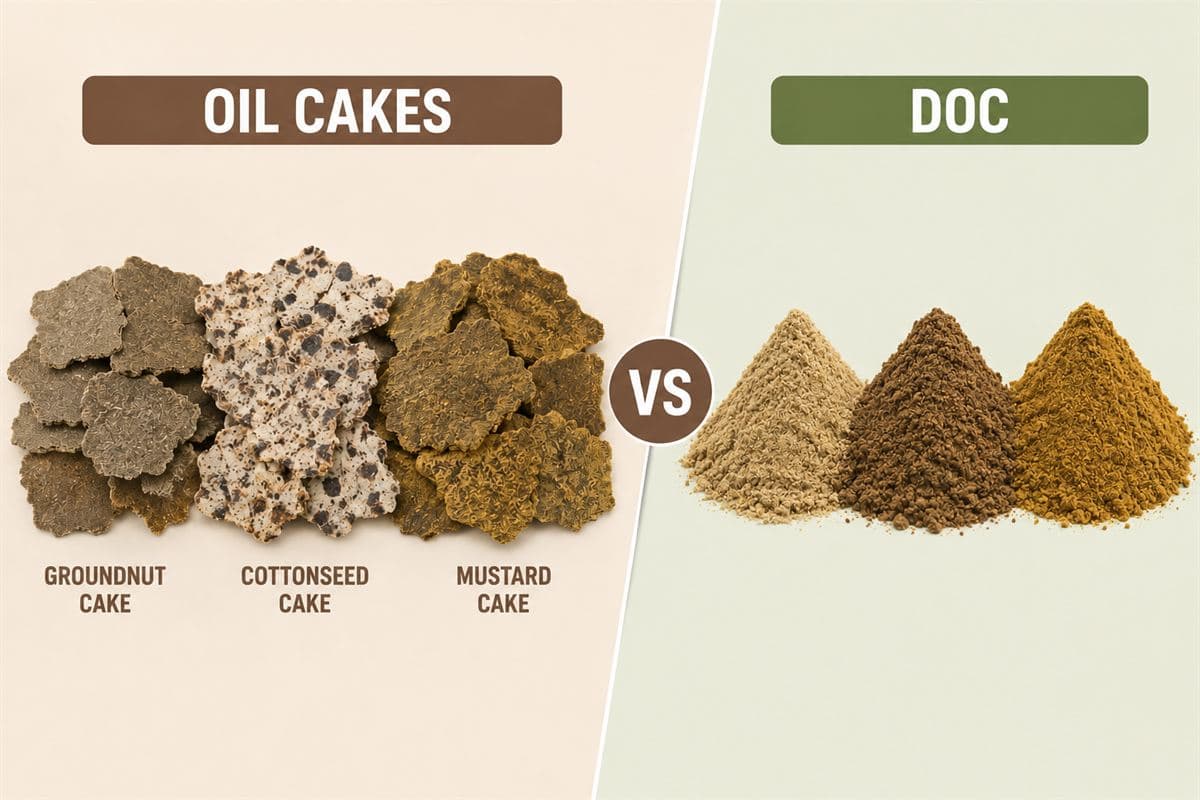
Oilseed Cake vs DOC (De-Oiled Cake / Meal) — Cottonseed, Groundnut & Mustard
Cake vs DOC (de-oiled cake/meal) in Indian cattle feed — cottonseed, groundnut, mustard. Protein, fat, price per protein, and when to use which.
Soybean Meal in Cattle Feed
Complete guide to soybean meal in Indian cattle feed — three grades (45/48/50% protein), BIS standards, inclusion rates for cow, buffalo, sheep, and goat.
Groundnut Cake (Mungphali Khal) in Cattle Feed
Groundnut cake (mungphali khal) in Indian cattle feed — 38-45% protein, coin-shape sizing, aflatoxin risk, BIS limits, and Saurashtra sourcing.