Compound Cattle Feed in India — BIS Type 1 vs Type 2
By Parv Badjatiya · Published Mon May 18 2026 00:00:00 GMT+0000 (Coordinated Universal Time) · Updated Mon May 18 2026 00:00:00 GMT+0000 (Coordinated Universal Time)
What is compound cattle feed?
Compound cattle feed is a scientifically formulated, ready-to-feed concentrate produced by blending energy ingredients, protein ingredients, fibre sources, minerals, salt, and additives into a single uniform product. In India it has become the dominant form of supplemental nutrition for cows, buffalo, sheep, and goats — replacing the traditional farm-mixed concentrate where each ingredient is weighed and combined by hand.
Compound cattle feed in India is governed by the Bureau of Indian Standards specification IS:2052 — Compounded Cattle Feeds, which defines composition, quality parameters, packaging, and labelling requirements. Any product sold under the label "cattle feed" in India must meet these specifications. The current Indian compound feed industry is also coordinated through the National Dairy Development Board (NDDB) at the standards-and-research level, particularly for the mineral mixture and bypass nutrient formulations cattle feed plants now ship across the country.
The current India market price for compound cattle feed is heavily linked to the underlying raw materials — daily prices for maize, soybean meal, DORB, cotton seed cake, and mineral mixture directly drive the cost of compounding.
Why compound feed is sold as pellets
In modern Indian dairy, compound cattle feed is sold almost entirely in pellet form — typically 4 to 10 mm cylindrical extruded pellets. The pellet diameter varies by grade and manufacturer convention: Type 1 (premium) is most commonly extruded at 4 mm, while Type 2 (standard) is most commonly extruded at 8 mm. Mash (loose ground form) and dal-style (with whole grains and lentils blended in) products still exist for specific regional markets, but pelleted feed is the default.
Four reasons pellets dominate:
- Reduced wastage and selective feeding. In a mash, an animal can pick out the tastiest particles (molasses-coated grain) and leave the rest. In a pellet, every bite delivers the formulated nutrition. Wastage drops from 8–15% (mash) to under 2% (pellets).
- Better palatability and intake. The high-pressure pelleting process partially gelatinises starch, breaks down fibre, and improves flavour. Animals eat pellets faster and in larger total volume.
- More accurate dosing. A scoop of pellets weighs predictably; a scoop of mash varies with packing density.
- Longer shelf life. Pellets have lower surface area exposed to humidity and oxygen, so they store better in monsoon conditions. Mash absorbs moisture faster and rancidifies sooner.
The pellet-making process is also where DORB — the cheap energy-and-fibre ingredient that is the largest by weight in most formulas — earns its place. DORB's natural starch and gum content acts as a binder during extrusion, holding the pellet together without expensive added binders.
BIS IS:2052 — Type 1 and Type 2 specifications
BIS classifies compound cattle feed into two grades, distinguished by protein, fat, and fibre content. The complete labelled specifications for both grades — as they appear on real BIS-compliant bags sold in the Indian market — are shown below.
Type 1 — Premium grade
| # | Parameter | Specification |
|---|---|---|
| 1 | Moisture (max) | 11% |
| 2 | Crude Protein (min) | 22% |
| 3 | Crude Fat (min) | 4% |
| 4 | Crude Fibre (max) | 10% |
| 5 | Sand Silica (max) | 3% |
| 6 | Total Phosphorus (min) | 0.5% |
| 7 | Available Phosphorus (min) | 0.25% |
| 8 | Calcium (min) | 0.8% |
| 9 | Vitamin A (IU/kg, min) | 7,000 |
| 10 | Vitamin D3 (IU/kg, min) | 1,200 |
| 11 | Vitamin E (IU/kg, min) | 30 |
| 12 | Salt (max) | 1% |
| 13 | T.G.U (max) | 1% |
| 14 | Aflatoxin B1 (ppb, max) | 20 |
| 15 | Cadmium (max) | 0.5% |
Type 2 — Standard grade
| # | Parameter | Specification |
|---|---|---|
| 1 | Moisture (max) | 11% |
| 2 | Crude Protein (min) | 20% |
| 3 | Crude Fat (min) | 3% |
| 4 | Crude Fibre (max) | 12% |
| 5 | Sand Silica (max) | 3% |
| 6 | Total Phosphorus (min) | 0.5% |
| 7 | Available Phosphorus (min) | 0.25% |
| 8 | Calcium (min) | 0.8% |
| 9 | Vitamin A (IU/kg, min) | 7,000 |
| 10 | Vitamin D3 (IU/kg, min) | 1,200 |
| 11 | Vitamin E (IU/kg, min) | 30 |
| 12 | Salt (max) | 1% |
| 13 | T.G.U (max) | 1% |
| 14 | Aflatoxin B1 (ppb, max) | 20 |
| 15 | Cadmium (max) | 0.5% |
The three parameters that distinguish Type 1 from Type 2
Of the 15 parameters on the label, only three differ between the two grades:
| Parameter | Type 1 (premium) | Type 2 (standard) |
|---|---|---|
| Crude Protein (min) | 22% | 20% |
| Crude Fat (min) | 4% | 3% |
| Crude Fibre (max) | 10% | 12% |
The other 12 parameters — moisture, sand silica, phosphorus, calcium, vitamins A/D3/E, salt, T.G.U, aflatoxin B1, and cadmium — must be met identically by both grades. Type 1 is the higher-quality, higher-protein, lower-fibre grade engineered for high-producing animals. Type 2 is the standard, more widely available, more affordable grade for general dairy use.
- Your animals yield over 10 L/day on average
- You have premium breeds (HF, Jersey crosses, Murrah buffalo)
- You're targeting maximum milk fat and yield
- You're feeding calf starter (calves need higher protein)
- You're in peak lactation (first 100 days post-calving)
- The price premium over Type 2 is under Rs 2/kg in your market
- You have mixed-yield herds with average production under 10 L/day
- You're feeding heifers, dry cows, or non-producing animals
- You're managing operating-cost discipline more than yield maximisation
- You're feeding sheep or goats (lower per-animal protein needs)
- Late-lactation cows tapering off milk
- General-purpose maintenance feeding
Many Indian dairy operations use both grades through the lactation cycle — Type 1 during peak lactation, Type 2 in late lactation and dry periods. The per-kg cost difference of Rs 1.5-3 between the two grades makes this an economical pattern as long as the farmer is disciplined about when to switch.
What T.G.U means on the label
T.G.U is a maximum-limit parameter (1% max) that constrains the level of toxic anti-nutritional compounds from oilseed cake inclusion — primarily gossypol (from cotton seed cake) and glucosinolates (from mustard cake). At 1% maximum, the limit ensures even a feed heavily reliant on oilseed cakes stays within safe levels for adult ruminants.
A note on TDN
The BIS specification historically referenced Total Digestible Nutrients (TDN) as a quality parameter — typically 75% min for Type 1 and 70% min for Type 2 — but TDN is a calculated/indicative number, not directly measurable on a label. The 15 parameters above are what actually appear on a compliant Indian compound feed bag.
The 20% protein rule — what most farmers don't know
There is a regulatory floor that every dairy farmer should understand:
A product cannot legally be labelled "cattle feed" in India if its crude protein is less than 20%.
This 20% minimum comes directly from the BIS IS:2052 Type 2 specification, which is the lowest-protein grade BIS recognises. A blend with 18% or 16% protein is not "cattle feed" in regulatory terms — it can be sold as a "cattle feed supplement" or a "feed ingredient mix" or under some other name, but the words "compounded cattle feed" cannot appear on the bag.
Why this matters when buying: if you see a 50 kg bag labelled prominently as "cattle feed" with the BIS mark, you know it must contain at least 20% crude protein. If a product is sold at a suspiciously low price and the label avoids the words "cattle feed," check the protein number — it may be a non-compliant blend marketed under a workaround name.
What happened to Type 3 (18% protein)
In recent years, BIS briefly recognised an additional grade with an 18% protein minimum — informally referred to in the industry as Type 3. The intent was to legitimise lower-protein, lower-cost blends for non-dairy or maintenance feeding. But the grade was subsequently de-recognised, and the 20% protein minimum was restored as the floor for any product labelled compound cattle feed.
The practical impact:
- Manufacturers who had launched 18% protein products had to either reformulate up to 20% protein or stop using the cattle feed label
- Some products were re-branded as "cattle feed supplements" or "cattle ration mix" to legally continue sales below the 20% floor
- The average nutritional quality of bagged products sold to Indian dairies rose
For a buyer, the takeaway is simple: any bag legitimately labelled compound cattle feed in India today must meet ≥20% crude protein. Anything less, regardless of marketing language, is a different category of product.
How shelf life differs between Type 1 and Type 2 in the market
A subtle market observation: bags of Type 1 compound feed typically carry a longer shelf life (around 2 months) from the date of manufacturing, while Type 2 bags often carry a shorter shelf life (around 45 days). The higher-quality, higher-fat grade is generally treated as more shelf-stable because its tighter vitamin and mineral fortification holds up better over time.
This is one of several quiet quality signals on a feed bag — a Type 1 product backing itself with a longer best-before window is signalling a more disciplined manufacturing and storage chain.
Type 1 vs Type 2 — regional and market split
Different Indian states show clear preferences between the two grades:
- Type 1 (premium) sees stronger demand in states with high-yielding herds and developed dairy markets — Punjab, Haryana, Gujarat, parts of Maharashtra, and around major cooperative milk-shed regions
- Type 2 (standard) is the workhorse grade across the bulk of India — Uttar Pradesh, Bihar, West Bengal, Madhya Pradesh, Andhra Pradesh, Telangana, Karnataka, and most smallholder operations
The split reflects underlying herd economics: where average milk yields are higher and farm-gate milk prices are stronger, Type 1's higher cost pays back through more milk and better fat. Where yields are mixed or lower, Type 2 is the right price-performance choice.
Many large farms use both — Type 1 during peak lactation (first 100 days post-calving) and Type 2 in late lactation, dry period, and for heifer maintenance.
Retail pricing (50 kg bag)
Indicative retail prices for general (non-stage) compound cattle feed in India:
| Grade | Typical price (₹/50 kg bag) | Per-kg cost (₹) |
|---|---|---|
| Type-1 (premium, 22% protein) | ~1,600 | ~32 |
| Type-2 (standard, 20% protein) | ~1,350 | ~27 |
The ₹250 spread per bag between the two grades reflects the difference in protein content, fat content, and (often) the quality of raw materials in the formulation. Daily feeding rates differ accordingly — a high-yielding cow on Type-1 typically eats less feed per litre of milk than the same cow on Type-2 because Type-1 delivers more nutrition per kg. For stage-specific feeds (calf starter, grower, heifer, pregnancy, close-up, transition), see our cattle feed stages guide — those come in the smaller 25 kg specialty bag at around ₹800 (roughly the same ₹32 per kg as Type-1).
Prices vary by region, brand, and raw material cost movements — see our daily raw material prices for what's driving compound feed prices upstream.
Typical compound cattle feed formulation
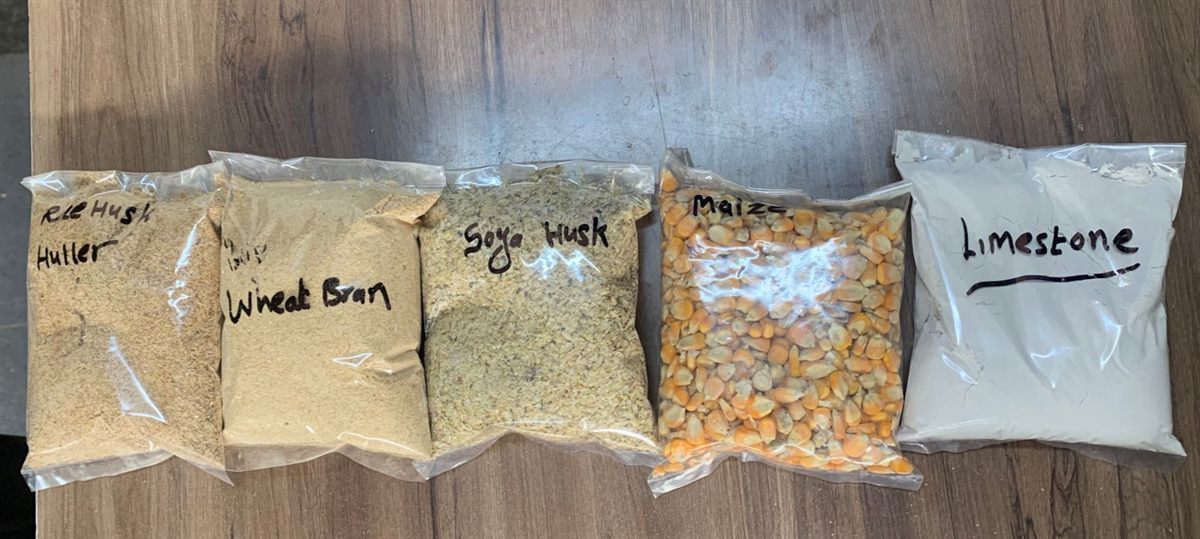 Common raw material inputs used in Indian compound cattle feed manufacturing — rice husk huller (a rice-milling by-product), wheat bran, soya husk, whole maize, and limestone (calcium source). Each ingredient is sourced separately, tested for moisture and impurities, and blended in the formulation. Original photograph.
A representative pelleted compound cattle feed formula:
| Ingredient | % of formula (Type 2) | % of formula (Type 1) |
|---|---|---|
| DORB | 25% | 18% |
| Maize | 20% | 22% |
| Soybean meal | 12% | 18% |
| Cotton seed cake | 15% | 18% |
| Groundnut cake / mustard cake | 10% | 10% |
| Wheat bran | 10% | 5% |
| Molasses | 4% | 4% |
| Mineral mixture | 2% | 2% |
| Common salt | 1% | 1% |
| Vitamin premix + additives | 1% | 2% |
The shift from Type 2 to Type 1 is mostly: more soybean meal, less DORB and wheat bran, and a slightly richer additive premix. This raises protein and reduces fibre — exactly the two parameters that distinguish the two grades.
Manufacturing process
Modern Indian compound feed mills follow a standard pellet manufacturing sequence:
- Raw material receipt and quality testing. Incoming maize, DORB, soybean meal, oilseed cakes, brans, and minerals are tested for moisture, protein, fibre, and aflatoxin against the supplier's CoA.
- Cleaning and grinding. Larger particles (whole grains, cake chunks) are ground to a uniform 2–4 mm particle size in a hammer mill.
- Batch weighing and dosing. Each ingredient is weighed to a recipe specification and dosed into a horizontal ribbon mixer or paddle mixer.
- Dry mixing. Ingredients are blended for 4–8 minutes to achieve uniform distribution.
- Conditioning. The dry mix is exposed to steam at 80–90°C in a conditioner, which raises moisture to 14–17% and partially gelatinises the starch.
- Pellet extrusion. The conditioned mash is forced through a pellet die under high pressure, producing 6–10 mm pellets.
- Cooling and drying. Pellets are cooled and dried to under 11% moisture for storage stability.
- Screening. Fines and broken pellets are sieved out and recycled back through the system.
- Final QC and bagging. Finished pellets are tested for crude protein, moisture, pellet durability, and bagged into 50 kg HDPE woven bags.
- Storage and dispatch. Bags are stacked, batch numbers logged, and dispatched within the shelf life window.
A mill running well will produce pellets with pellet durability index (PDI) above 90%, meaning more than 90% of pellets survive normal handling without crumbling into fines.
How to read a compound cattle feed bag
A compliant 50 kg bag of compound cattle feed in India will display the following on the label:
Identification and certification:
- Brand name and product sub-tier indicator (manufacturers often use proprietary tier names or symbols to distinguish their grade levels)
- BIS specification declaration — explicitly stated as "AS PER BIS SPECIFICATION TYPE-I" or "AS PER BIS SPECIFICATION TYPE-II"
- The IS:2052 mark with the BIS license number (format: CM/L-XXXXXXXXX)
- "BALANCED CATTLE FEED" / "संतुलित पशुआहार" labelling (often in both English and Hindi)
- Manufacturer's full name and registered address
Nutritional declaration (all 15 parameters):
- Moisture % (max), Crude Protein % (min), Crude Fat % (min), Crude Fibre % (max)
- Sand Silica % (max), Total Phosphorus % (min), Available Phosphorus % (min), Calcium % (min)
- Vitamin A (IU/kg, min), Vitamin D3 (IU/kg, min), Vitamin E (IU/kg, min)
- Salt % (max), T.G.U % (max), Aflatoxin B1 (ppb, max), Cadmium % (max)
Pack and traceability:
- Net weight: 50 kg (at the time of packing)
- Batch number (see-on-pack)
- Manufacturing date (see-on-pack)
- Best before date (typically 45 days for Type-II, 2 months for Type-I)
- Maximum Retail Price (₹) inclusive of all taxes
- Recycling symbol (5 / PP for polypropylene woven sack)
- Handling instructions ("USE NO HOOKS" to protect the bag)
Feeding guidance:
- Daily feeding quantity table (cow vs buffalo) often shown in both Hindi and English
- For body maintenance: cow 1.5 kg/day, buffalo 2 kg/day is a common baseline
- Higher quantities required for lactating and high-yielding animals
Storage instructions:
- "Store in a cool, dry and ventilated place devoid of moisture" / "पशु आहार को नमी से बचाकर सूखे एवं हवादार स्थान पर रखें"
Bags that don't carry this complete information — especially the BIS specification declaration, BIS license number, and full nutritional declaration — should be approached with caution. The brand may still be acceptable, but you have no regulatory protection if the product doesn't meet specification.
Daily feeding rates
Standard feeding rates for compound cattle feed (Type 1 or Type 2):
| Animal class | Compound feed per day |
|---|---|
| Lactating cow (low yield, 4–6 L) | 2–3 kg |
| Lactating cow (medium yield, 6–10 L) | 3–5 kg |
| Lactating cow (high yield, 10+ L) | 5–7 kg (Type 1 recommended) |
| Lactating buffalo (6–8 L) | 3–4 kg |
| Lactating buffalo (8–10 L) | 4–6 kg |
| Lactating buffalo (10+ L) | 6–8 kg (Type 1 recommended) |
| Dry cow / dry buffalo | 1.5–2.5 kg |
| Heifer (above 1 year) | 1.5–2 kg |
| Calf starter (after weaning) | 0.5–1.5 kg, scaling with age |
| Bull (breeding) | 2–3 kg |
A working rule used in Indian dairy practice: 1 kg of compound feed for every 2 litres of milk produced, plus 1.5–2 kg of maintenance allowance regardless of yield. For peak lactation buffalo, add 100–300 g of bypass fat top-dressed onto the compound feed.
Pellet quality: what to check before buying
A good pellet:
- Holds together — should not crumble easily when squeezed between fingers
- Uniform colour — dark brown is typical; black patches suggest burning or contamination
- Uniform diameter — 6–10 mm range, consistent across the bag
- Less than 5% fines — large quantities of dust at the bottom of the bag indicate poor PDI
- No mould smell — fresh, slightly toasted aroma is normal
- No live insects or webbing — sign of old or poorly stored stock
A poor pellet:
- Crumbles easily into a fine powder when handled
- Heavy fines at the bottom of the bag (more than 10%)
- Uneven sizes suggest worn pellet die at the mill
- Sour smell — indicates moisture spoilage
- Visible mould or musty smell — reject
Storage best practices
Compound feed pellets are reasonably stable but not invincible:
- Off-floor stacking on wooden or plastic pallets
- Bag stacking maximum 12–15 high
- Cool, dry storage below 30°C and 70% relative humidity
- FIFO rotation based on manufacturing date (printed on the bag)
- Buffer time — 2–3 months is comfortable; beyond 4–5 months, vitamin premix activity declines
- Pest control — rats and storage insects are the main enemies
- Don't store next to fertilisers, pesticides, or strong-smelling materials — pellets absorb odours
Compound feed vs farm-mixed concentrate
The choice between buying ready compound feed and mixing your own concentrate from individual ingredients depends on scale, capability, and price:
| Factor | Compound cattle feed (buy ready) | Farm-mixed concentrate |
|---|---|---|
| Consistency | Very high (BIS-compliant) | Depends on farmer's discipline |
| Mineral balance | Built-in mineral mixture | Easy to skip or under-dose |
| Price per kg | Higher (factory cost + margin) | Lower (raw material cost only) |
| Convenience | High (open bag, feed) | Low (weigh, mix, feed daily) |
| Quality control | Manufacturer's QC + BIS | Depends on raw material sourcing |
| Scalability | Easy for small and large herds | Time-intensive at small scale; cost-effective at large scale |
| Storage | Long shelf life | Shorter for ground raw materials |
For most Indian smallholder dairies (under 10 animals), compound feed is the right choice. For larger commercial dairies with their own grinding and mixing equipment, farm-mixing is cheaper per kg. The crossover point is usually around 30–50 animals.
Conclusion
Compound cattle feed is the modern foundation of Indian dairy nutrition. The Bureau of Indian Standards specification IS:2052 defines two grades — Type 1 (≥22% protein) for high-yielding herds and Type 2 (≥20% protein) for general use — and sets the legal floor for any product labelled "cattle feed" in India. The pelleted format dominates because it reduces wastage, improves intake, and stores better than mash. The 20% protein floor protects buyers from sub-quality blends marketed under the cattle feed name.
For a dairy farmer, the practical guidance is straightforward: buy from established manufacturers, check the bag for the BIS mark and nutritional declaration, prefer Type 1 for peak-lactation animals and Type 2 for general feeding, store properly, and feed at roughly 1 kg per 2 litres of milk plus a 1.5–2 kg maintenance allowance. Done right, compound cattle feed is the simplest path to consistent, BIS-compliant nutrition — which is the foundation of every profitable Indian dairy.
Frequently asked questions
What is compound cattle feed?+
What is the difference between BIS Type 1 and Type 2 compound cattle feed?+
Why is compound cattle feed always sold as pellets in India?+
Why can't you use the words cattle feed on a bag with less than 20% protein?+
What happened to the 18% protein Type 3 compound cattle feed?+
Which is better for my dairy - Type 1 or Type 2 compound cattle feed?+
Related articles
Cattle Feed Stages Explained — Starter, Grower, Heifer, Pregnancy, Close-Up & Transition
Stage-by-stage guide to compound cattle feed in India — starter, grower, heifer, pregnancy, close-up & transition pellets (BIS Type-1, no urea, 25 kg).
Feeding Lactating Cow: Complete Ration Guide
Feeding lactating dairy cows in India — Type-1 vs Type-2 compound feed by milk yield, sample rations, 21-day transition, and breed-specific notes.
Monsoon Dairy Management: Protect Cattle, Feed & Milk Yield
Monsoon dairy management for Indian farmers — feed mould and aflatoxin control, mastitis prevention, hoof care, and a pre-monsoon checklist.