How to Export Cattle Feed from India — Documents, Buyers, Packaging & Container Loading
By Parv Badjatiya · Published Tue Jun 09 2026 00:00:00 GMT+0000 (Coordinated Universal Time) · Updated Tue Jun 09 2026 00:00:00 GMT+0000 (Coordinated Universal Time)
Exporting cattle feed from India is a real opportunity but not exactly what most newcomers expect. The largest export volumes are not finished compound feed — they are the raw materials and supplements that go into compound feed. Below is a practical, end-to-end guide to what you can actually export, the paperwork you will need, where to find buyers, how to handle payment and packaging, and the container-loading details that catch new exporters off guard.
What India actually exports (and what it doesn't)
| Product category | Export volume from India | Why |
|---|---|---|
| Finished compound cattle feed (pellets) | Small | Heavy, bulky, low margin per kg, perishable. Most importers make feed closer to home from imported raw materials. |
| Raw materials — soybean meal, maize, DORB, oilseed cakes, DOCs, DDGS, brans | Large | India is a major global supplier. See our daily wholesale prices for the 21 commodities we track. |
| Supplements — mineral mixtures, bypass fat, vitamins, amino acids, urea, calcium | Moderate to large | Higher value per kg, longer shelf life, lighter to ship. Strong margins. |
The practical takeaway: if you are setting up a cattle feed export business in India, plan around raw materials and supplements, not finished pellets. Compound feed export does happen — usually to neighbouring countries with smaller feed industries — but the volumes are modest compared to the raw material trade.
Top destination markets
The major buyers of Indian cattle feed and feed-ingredient exports:
Bangladesh           ████████████████  (large, all categories)
Vietnam              ████████████      (SBM, DOC, DDGS)
China                ███████████       (rapeseed meal, DDGS)
Indonesia            ████████          (SBM, cakes)
Thailand             █████████         (SBM, DOC)
Middle East (UAE etc) ██████           (supplements, husks)
Sri Lanka            █████             (compound feed + raw)
East Africa (KE, TZ) ████              (raw + supplements)
These flows shift with global price relationships, but Bangladesh and Vietnam are usually the two largest buyers of Indian cattle feed material across categories.
Documents you must have
You cannot ship a single bag legally without these. Some destinations need additional documents (Halal certificate for Gulf countries, USDA-style certificates for the US, BNAFA for Bangladesh), but the following are the baseline for almost every country:
| Document | What it is | Who issues it |
|---|---|---|
| IEC (Import-Export Code) | A unique 10-digit code issued by DGFT (Directorate General of Foreign Trade). One-time registration. Without IEC you cannot export anything. | DGFT online portal |
| RCMC (Registration-Cum-Membership Certificate) | Required to claim export incentives and prove industry membership. For cattle feed, normally issued by APEDA, FIEO, or the relevant Export Promotion Council. | APEDA / FIEO |
| Phytosanitary Certificate | Plant-product health certificate confirming the consignment is free of pests, weeds, and contaminants. Mandatory for plant-origin items (cakes, meals, DDGS, bran, husk). | Plant Quarantine office at the export port |
| Fumigation Certificate | Proof that the container or cargo has been fumigated against pests. Almost universally required for plant-origin feed material. | Accredited fumigator at the port |
| MSDS (Material Safety Data Sheet) | Standard product-safety document with composition, hazards, handling instructions. Many countries ask for it even for non-hazardous feed materials. | You prepare it (using a template), buyer-side authorities accept it |
| Lab Report / Certificate of Analysis (COA) | Independent NABL-accredited lab report showing the product matches the buyer's specification — protein, moisture, fat, fibre, aflatoxin, mycotoxins, salmonella, etc. | NABL lab (e.g. SGS, Intertek, Eurofins) |
| Commercial Invoice | The export sale document — buyer/seller details, HS code, quantity, value, payment terms, Incoterms. | You issue it |
| Packing List | Lot-by-lot breakdown — number of bags, bag weights, container number, seal number, gross/net weight. | You issue it |
For specific destinations you may also need: Country of Origin certificate (Chamber of Commerce), Halal certificate (for Middle East), GMO-free declaration (for EU), organic certificate (for organic feed), or veterinary health certificate (for compound feeds with animal-derived inputs).
HSN codes — get this right before you ship
Every Indian export invoice must carry the correct HSN (Harmonized System of Nomenclature) code for the product. The HSN code determines:
- Customs duty calculation at the destination port
- Eligibility for Indian export incentives like RoDTEP and duty drawback
- Whether the consignment clears or gets held at the export port
- How the buyer classifies the product for their own import paperwork
Wrong HSN code on the invoice is one of the most common — and most expensive — first-time exporter mistakes. We have seen containers held at JNPT for 7-15 days over an HSN dispute, and refusal of RoDTEP claims worth lakhs of rupees because the wrong code was used.
Common HSN codes for cattle feed exports (verify before using):
| Product | HSN code |
|---|---|
| Compound cattle feed (mixed prepared feed) | 23099010 |
| Soybean meal (defatted) | 23040030 |
| Mineral mixture / other prepared animal feed | 23099090 |
| Cottonseed oil cake / meal | 23061010 / 23061090 |
| Mustard / rapeseed oil cake (low-erucic) | 23064100 |
| Mustard / rapeseed oil cake (other) | 23064900 |
| Groundnut oil cake | 23050010 / 23050020 |
| Wheat bran | 23023000 |
| Rice bran (de-oiled or other) | 23024000 |
| Maize germ oil cake / DDGS / DOC | 23030000 family |
| Cane molasses | 17031000 |
| Feed-grade / technical urea | 31021000 |
Important caveats:
- HSN codes get updated periodically by the CBIC (Central Board of Indirect Taxes and Customs). What's current today may shift in a future budget. Always cross-check against the latest CBIC tariff schedule before shipping.
- Buyer's import country may use a slightly different code (HSN is harmonized to 6 digits internationally, but each country adds its own 2-4 digit extension). Confirm with your buyer what code their customs broker prefers.
- The "best" HSN can change with end-use — the same physical product can fall under different codes depending on whether it's labelled "feed-grade", "industrial-grade", or "food-grade". Read the description in the tariff schedule, not just the title.
- For new or unusual products, ask your CHA (Customs House Agent) for a written HSN opinion before printing invoices. A 5-minute phone call avoids a 7-day port hold.
The three codes our daily price tracker commodities most often map to: 23099010 (compound feed), 23040030 (soybean meal), 23099090 (mineral mixture and other supplements). Use these as anchors but always verify against the current CBIC schedule for each shipment.
How to find buyers
There are five practical channels. Most new exporters use a mix of all five:
1. Your own website
A clean website with your product list, capacity, certifications, and a contact form is the most credible source of leads. Buyers searching "Indian DDGS supplier" or "soybean meal India FOB" arrive directly. Costs almost nothing per lead once it ranks.
2. B2B portals
The major ones in India:
- IndiaMart — biggest by volume, lots of buyers, lots of competition
- TradeIndia — similar profile to IndiaMart
- ExportersIndia
- Volza — paid trade-data platform, useful to see who is actually importing from India and what they pay
- The Dollar Business — trade-data + paid lead service
Paid memberships on these portals generate enquiries but quality varies. Treat them as a top-of-funnel lead source.
3. Trade exhibitions
- AAHAR / India Foodex (Delhi)
- Krishi Expo
- Poultry India (the cattle/poultry feed line overlaps)
- Gulfood (Dubai) for Middle East buyers
- VIV Asia (Bangkok) for poultry/feed industry
Exhibitions are expensive but a single trade-show buyer relationship can be worth lakhs of rupees over years. Best ROI when you go in your second or third year, not as a first-time exporter.
4. Trade-data platforms
Volza and The Dollar Business publish import-export shipping data. You can search by HS code (e.g. 23040000 for soybean cake/meal) and see exactly which Indian exporter shipped to which foreign buyer, when, at what price. This is the best way to identify active buyers — they are already importing, you just need to reach out.
5. Existing-buyer referrals
Once you have one or two satisfied buyers, ask them for introductions in adjacent markets. International feed buyers know each other.
Payment terms — in order of safety
You will hear about many payment terms. For a new exporter, the order of safety is:
| Term | Risk to you | When to use |
|---|---|---|
| 100% Advance (TT) | Lowest | Always your first preference, especially for first-time buyers. If a buyer refuses any advance at all, that is a red flag. |
| 30% Advance + 70% against B/L copy | Low | Common compromise. You ship after 30% lands. The remaining 70% should clear before the original Bill of Lading reaches the buyer's port, otherwise the buyer cannot clear the container. |
| Irrevocable L/C (Letter of Credit) | Low if from a reputable bank | The buyer's bank guarantees payment if you produce specified documents. Banks like HSBC, Standard Chartered, Citi, major European/Japanese banks are reliable. Some smaller national banks in Africa or West Asia have a history of disputes. |
| Bank Guarantee | Medium | Less liquid than an L/C. Usually combined with other terms. |
| DA / DP (Documents against Acceptance / Payment) | High | Goods released to buyer before payment confirms. Avoid until you trust the buyer. |
| Open Account (full credit) | Very high | Only for old, trusted relationships. Never as a first transaction. |
Practical rule: for your first three shipments to any new buyer, insist on 100% advance. Buyers serious about a long relationship will accept this. Buyers who refuse are typically the ones who later default. The ₹3-5 lakh you protect by being firm on this rule is worth more than the volume you might lose on hesitant buyers.
Moisture & shelf life — the silent revenue killer
Sea freight to South-East Asia takes 7-14 days. To East Africa, 18-25 days. To Europe, 25-30 days. Plus 5-15 days for port clearance at the destination. Your product can be in transit for 6 weeks or more before it reaches the end customer.
What goes wrong in 6 weeks of sea transport:
- Moisture migration in the container — cooler container walls cause condensation, dripping back onto the bags
- Aflatoxin development in any plant-origin material (especially groundnut cake and maize)
- Mould / fungal growth if moisture exceeds ~12-13%
- Caking in mineral mixtures and salt
- Rancidity in fat-containing products like bypass fat
Practical defences:
- Cap moisture at 10-12% for cake/meal/grain items at the time of loading. Lower than you would for domestic sale.
- Use moisture absorbers (silica gel pouches) inside the container.
- Desiccant blankets stretched over the cargo prevent condensation drip.
- Test for aflatoxin at loading — anything close to the destination country's limit will fail when retested at port of arrival.
Packaging — what buyers actually ask for
Three packaging options dominate:
| Packaging | When to use |
|---|---|
| 50 kg PP bags (polypropylene woven) | Standard, cheapest. Default for most exports. |
| 50 kg BOPP bags (BOPP-laminated PP) | Better moisture barrier, glossier print finish, used when the buyer wants retail-grade presentation. ₹5-15 more per bag. |
| Jumbo / FIBC bags (500-1500 kg) | Used when the buyer will tip directly into a feed-mill silo at destination. Saves labour. Bigger commercial buyers prefer this. |
Always confirm bag specification, print artwork, and labelling language with the buyer before the bagging line runs. Reprinting bags is expensive; relabelling a 20-MT container by hand is brutal.
Container types and loadability
This is the part that catches first-time exporters by surprise.
| Container | Internal volume | Cake / meal / grain loadability | Husk / bran (light) loadability |
|---|---|---|---|
| 20-foot | About 33 cubic metres | 19-20 MT | 9-12 MT (volume-limited, not weight-limited) |
| 40-foot | About 67 cubic metres | 27-28 MT | 15-18 MT |
The critical rule: dense items like soybean meal, cotton seed cake, groundnut cake and grain hit the weight limit before the volume limit. So a 20-foot container is full at ~20 MT of cake even though there is still space.
Light items like cottonseed husk, soya husk, paddy husk, huller bran hit the volume limit first. A 20-foot container of cottonseed husk fills up at ~9-10 MT, well below the weight cap. This dramatically changes your per-kg sea freight cost.
Always confirm whether a husk item ships at weight or volume capacity before quoting an FOB price. Quote at weight capacity for a husk item and your sea freight per kg can wipe out your entire margin.
End-to-end export process (typical timeline)
For a 20-foot container of cake/meal to South-East Asia:
| Stage | What happens | Days |
|---|---|---|
| 1 | Buyer enquiry → quotation → buyer accepts | 3-10 |
| 2 | Buyer issues Purchase Order (PO) — never skip this step | 1-3 |
| 3 | Advance payment (or L/C confirmation) received in your bank | 3-7 |
| 4 | Production / packaging / pre-shipment lab testing | 5-10 |
| 5 | Container booking with shipping line | 2-3 |
| 6 | Fumigation, phytosanitary inspection at port | 2-3 |
| 7 | Stuffing the container at the warehouse / CFS | 1 |
| 8 | Customs clearance + final document set | 2-3 |
| 9 | Container loaded onto vessel, sails | 1-2 |
| 10 | Sea transit | 7-30 (depending on destination) |
| 11 | Buyer's port clearance | 5-15 |
| 12 | Final balance payment cleared (if not advance) | 1-5 |
| Total | First inquiry → cash in bank | 35-90 days |
Two non-negotiable rules:
- Always get a written PO before starting production. Verbal commitments evaporate when commodity prices move 5% during your packaging window.
- Always fumigate the container before stuffing. Skipping this saves ₹3,000-5,000 but can fail the buyer's port inspection — which costs the entire container's value if the destination rejects it.
Common mistakes that cost real money
We have seen first-time Indian cattle feed exporters lose ₹5-50 lakh on these:
- Shipping without a PO — buyer changes their mind mid-transit, refuses to take delivery, you scramble to find a backup buyer at the destination port at distress prices.
- Trusting "advance after loading" promises — buyer asks for the Bill of Lading, then refuses to release the advance. You lose the container.
- Quoting husk items at cake-loading weight — you assume 20 MT in a 20-foot container, the actual loadable is 10 MT, your sea freight per kg doubles.
- Skipping the aflatoxin pre-load test — destination country rejects on arrival, you cannot easily re-export to a third country.
- Underestimating destination port delays — pricing on 7-day transit and 5-day clearance when reality is 25 + 15 days. Bank cycle costs eat the margin.
- Not building in a moisture buffer — 13% moisture at loading becomes 15-16% after transit, fails buyer's incoming inspection.
- Letting bag printing run before final buyer artwork approval — ₹50,000-1 lakh in scrapped bags.
- Using the wrong HSN code on the commercial invoice — container held at port for 7-15 days while customs disputes the classification. Worse, RoDTEP and duty drawback claims get rejected later. Always confirm the HSN with your CHA before printing invoices. See the HSN codes section above.
Where to start, practically
If you are a manufacturer or dealer thinking about export, here is the 7-step launch sequence in order:
- 1Apply for IEC (Import-Export Code)
Online via DGFT portal, free, takes about a week. You cannot export a single bag without this 10-digit code.
- 2Get RCMC (Registration-Cum-Membership Certificate)
From APEDA or FIEO depending on your product category. Required to claim export incentives like RoDTEP and duty drawback.
- 3Pick one or two products from your existing range
Don't try to export 10 products at once. Choose what you have surplus capacity in and the cleanest QC track record on.
- 4Use Volza or The Dollar Business to find active buyers
Trade-data platforms show exactly which importers are currently buying your HS code from other Indian exporters. Reach out to those buyers, not random leads.
- 5Build a simple website with product specs, photos, and a contact form
Buyers Google you before they reply to any email. A 4-page site is enough — home, products, certifications, contact.
- 6Quote conservatively on the first container
Lose a little margin to land the relationship. Raise prices once the buyer trusts you and has paid 2-3 shipments without dispute.
- 7Insist on 100% advance for the first three shipments
No exceptions. This single rule eliminates the most common path to losing a container's value.
Always 100% advance payment for the first three shipments to any new buyer. Buyers serious about a long relationship will accept this. Buyers who refuse are typically the ones who later default. The ₹3-5 lakh you protect by being firm on this rule is worth more than the volume you might lose on hesitant buyers.
The Indian cattle feed export industry is real and growing — but the people who do well are the ones who treat the paperwork and quality control as seriously as the price negotiation.
Related reading
- How Cattle Feed is Sold in India — Dealers, Distributors, BMCs, Schemes
- How to Start a Dairy Farm in India 2026
- Compound Cattle Feed in India — BIS Type 1 vs Type 2
- Daily India wholesale prices — the raw material prices you will quote against
- Aflatoxin in Cattle Feed — BIS limits and testing — critical for export quality
Frequently asked questions
Can I export Indian compound cattle feed (pellets) in bulk?+
What is the minimum quantity to start exporting cattle feed?+
Which countries import the most cattle feed raw material from India?+
Is advance payment really safe? What about L/C?+
Related articles
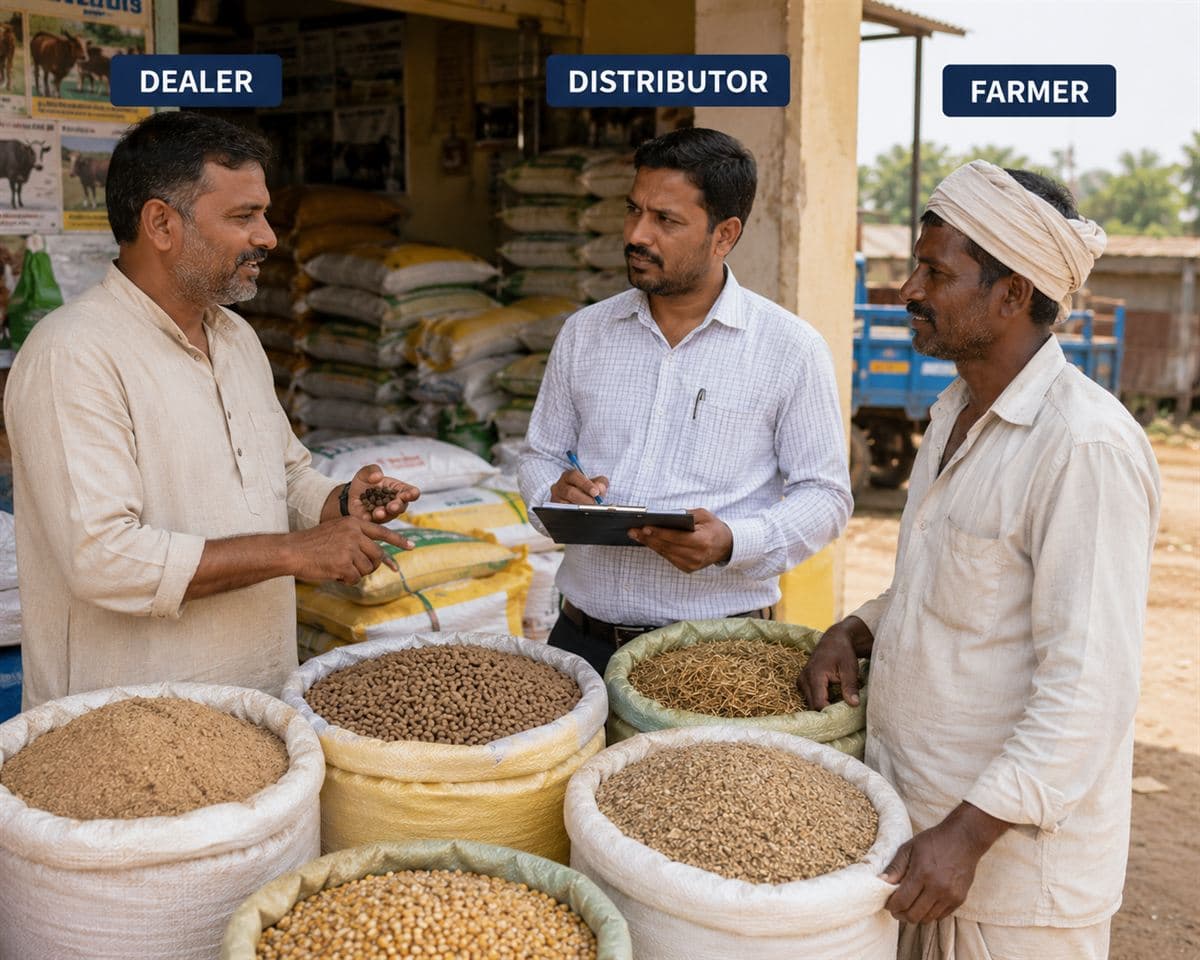
How Cattle Feed is Sold in India — The 5 Distribution Channels Explained
How cattle feed actually moves from factory to farmer in India — dealers, BMCs, distributor warehouses, schemes, and in-bag farmer gifts explained.
How to Start a Dairy Farm in India — Cost, Profit & Government Subsidies (2026)
Honest guide to starting a small dairy farm in India — real costs, monthly profit math, NABARD and government schemes, and mistakes to avoid.
Cattle Insurance in India — Schemes, Premiums & Claim Process (2026)
Complete guide to cattle insurance in India — government schemes, premiums (2.5-4.5%), subsidies up to 90%, claim process, and how to apply.