How to Start a Dairy Farm in India — Cost, Profit & Government Subsidies (2026)
By Parv Badjatiya · Published Fri May 22 2026 00:00:00 GMT+0000 (Coordinated Universal Time) · Updated Fri May 22 2026 00:00:00 GMT+0000 (Coordinated Universal Time)
So you're thinking of starting a dairy farm.
Maybe you've been watching YouTube videos of farmers with clean sheds and glossy Friesian cows, hearing numbers like "earn fifty thousand a month from five cows," and the idea is sticking. Or maybe you've grown up around animals and now want to do this properly — as a business, not a backyard.
Either way, this guide is meant to give you the real picture. Not the YouTube version. The actual one — what it costs, what you'll earn, where it gets hard, and how to give yourself the best chance of making it work.
I'll walk through it the way I'd explain it to a friend over chai, not as a textbook.
These numbers are the honest picture for a five-cow crossbred HF dairy in 2026. The numbers below are not best-case — they are typical-case. Best-case is 20-30% higher; worst-case is 30-40% lower. Most new farms land in the typical range.
First, an honest expectation
A small dairy farm in India is a business that takes 18 to 24 months to break even, demands work 365 days a year, and rewards patience more than ambition. The farms that succeed are usually run by people who:
- Already own or can lease the land for free or very cheap
- Are doing it as a family operation, not paid labour for everything
- Treat it as a five-year project, not a quick income source
If you're thinking of borrowing a lot of money, paying for everything (land, labour, feed) at market rates, and expecting to be profitable within a year — please read that paragraph twice. Those farms tend to fail in the first 18 months.
The good news is the opposite of that picture. With the right scale, decent management, and the government subsidies that are actually available, a smallholder dairy can be a genuine path to a steady second income, and over years can grow into a primary income for the family.
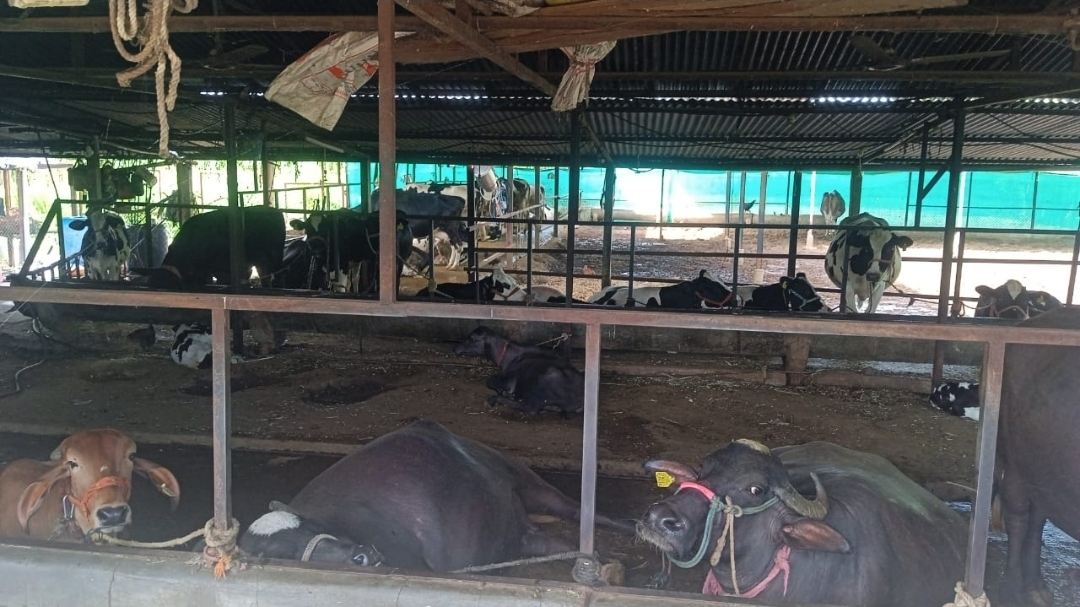 A working smallholder dairy with crossbred HF cows and Murrah buffaloes in a tied-stall shed. Tin roof, side curtains, green shade netting for summer heat, ear-tagged animals, concrete floor sloped for drainage — basic but disciplined management. This is what a typical Indian small dairy looks like in practice. Original photograph.
How much does it really cost to start?
Let me give you a concrete example. This isn't the only way — it's a realistic mid-scale starter setup that works in most parts of India.
Scenario: five crossbred HF cows, zero-grazing system, on land you already own.
The one-time capital you'll need works out roughly like this. A simple shed for five cows with proper drainage and feed troughs costs ₹1.5 to 2 lakh. Water arrangements — storage drum, taps, and a small pump if you don't have piped water — another ₹15,000 to ₹25,000. The five cows themselves, in early lactation and giving 10 to 15 litres a day each, run ₹3 to 4 lakh. A chaff cutter (manual or small motorised) is ₹15,000 to ₹35,000. Milk cans, buckets, ropes, ear tags and a basic tool kit add another ₹10,000. Initial fodder stock — Napier saplings to plant plus one month of dry fodder — is around ₹15,000. And budget ₹15,000 for AI starter kit, deworming, vaccinations, and insurance signup.
Add it up and you're looking at roughly ₹5.5 to ₹7 lakh for a real, working five-cow unit.
Now this number can move a lot depending on choices. If you also need to buy the land, add ₹10 to 50 lakh depending on state. If you go for higher-yielding pure Friesians at 20+ litres a day, add ₹50,000 to ₹1 lakh per cow. A fancier shed with rubber mats, fans, and sprinklers will add ₹1 to 2 lakh. If you start with buffalo instead — Murrah or Jaffarabadi — each animal costs ₹70,000 to ₹1.2 lakh, more than HF crossbred.
For most readers, the realistic starter range is ₹6 to ₹10 lakh for everything except land.
What you'll spend every month
Once the farm is running, the monthly bill for that same five-cow setup, assuming each cow averages 12 litres a day, breaks down roughly as follows.
Concentrate feed is the biggest line item. Six kilograms per cow per day means 900 kilograms a month, and at around ₹30 per kilogram that's roughly ₹27,000. Green fodder is the next biggest swing factor: if you grow your own Napier you'll spend about ₹2,000 a month on fertiliser; if you buy from the market, ₹8,000 to ₹12,000. Dry fodder — paddy straw or wheat bhusa — runs ₹3,000 to ₹5,000. Mineral mixture and salt cost about ₹500. AI service charges, routine deworming, and small vet calls add roughly ₹1,500. Electricity for the water pump, fan, and lights is ₹1,000 to ₹2,000. And then there's labour: ₹6,000 to ₹12,000 if you hire a part-time helper, zero if it's family doing the work.
Total monthly running cost: somewhere between ₹40,000 and ₹55,000, with the biggest variable being whether you grow your own fodder and whether labour is paid or family.
What you'll actually earn
This is where most people get the numbers wrong.
Five cows times 12 litres a day times 30 days gives you 1,800 litres of milk a month on paper. But that's gross production, not saleable milk. Some of it goes to the calf — typically 3 to 5 litres per cow per day for the first three months after calving. Some goes to the household if you're consuming it at home. Some is lost to spillage, mistimed milking, or the calving-gap days when a cow is dry between lactations.
In practice, you'll have about 1,500 litres of saleable milk a month from a well-managed five-cow herd, often less, especially in summer.
At cooperative or local rates of ₹35 to ₹45 per litre (depending on region and fat percentage), that's monthly revenue of ₹52,500 to ₹67,500.
So a working five-cow farm grosses roughly ₹55,000 to ₹65,000 a month, costs ₹40,000 to ₹55,000 to run, and nets ₹10,000 to ₹20,000 in cash for the family.
If you've taken a loan to set this up, the EMI eats most of that. A ₹6 lakh, 7-year dairy loan at 9% works out to around ₹9,500 a month. Which is exactly why people who already own land and have family labour do better — they're not paying market rates for inputs they already have access to.
What changes the numbers most
A handful of decisions move profitability more than anything else.
The first is milk yield per cow. A 15-litre-a-day cow earns 50% more than a 10-litre-a-day cow but only costs about 25% more to feed. The single most profitable action a dairy farmer can take is buying better cows, feeding them properly, and getting them to their genetic potential. Our feeding lactating cow guide and compound cattle feed guide cover the practical side.
The second is growing your own green fodder. If you have even half an acre, planting Napier and intercropping a protein legume like Desmodium can cut your feed cost by 30 to 50 percent. Almost every profitable smallholder dairy I've seen in India does this — the ones that buy all their fodder from the market tend to operate on razor margins.
The third is the milk price you actually get. Selling to a cooperative — KMF, Amul, Mother Dairy, Saras, Sangam, NDDB-linked unions — is reliable but lower paying. If you're near a town and can sell 30 or more litres a day at the doorstep at ₹50, your income jumps significantly. The trade-off is the time it takes, the small risk of unsold milk on bad days, and the customer-management headache.
The fourth is disease prevention. One serious mastitis case, one lost calf, one heat-stroke death in summer — any of these can wipe out a full month's profit. The farms that thrive treat preventive care as non-negotiable: deworming every three months, AI from a proven bull, mineral mixture every day, clean water around the clock, and basic shed hygiene. None of it is expensive. All of it is forgotten under pressure.
The schemes that actually help
There's a lot of confusion online about dairy subsidies. Here's what's actually working in 2026 and worth knowing about.
Dairy Entrepreneurship Development Scheme (DEDS) under NABARD. This is the main one most smallholders end up using. You take a loan from a participating bank — commercial, regional rural, or cooperative — and NABARD gives a back-ended capital subsidy of 25 percent for general category applicants and 33.33 percent for SC/ST/NER applicants. "Back-ended" means the subsidy parks itself in your loan account and is released only after you've paid the rest off correctly. It reduces what you ultimately repay rather than what you receive upfront. Your bank prepares the project report with you and routes it through NABARD's regional channel.
National Livestock Mission (NLM). Run by the Department of Animal Husbandry & Dairying. The Entrepreneurship Development sub-component offers up to 50 percent capital subsidy on eligible project cost. In recent years the focus has shifted somewhat toward goats, sheep, pigs and poultry, but cattle units in eligible states can still apply. Applications go through the Udyami Mitra portal or your state animal husbandry department directly.
Kisan Credit Card (KCC) for Animal Husbandry. Less of a "scheme" and more of a banking product, but extraordinarily useful. KCC for animal husbandry gives you a working-capital limit — typically ₹1.6 lakh in the first year without collateral, up to ₹3 lakh with collateral — at an effective interest rate of around 4 percent after government subvention if you repay on time. It covers feed, vet bills, AI charges, and replacement costs. If you're starting small, KCC is often a better first step than a large term loan. Easier to qualify for, easier to manage.
State-specific schemes. Most state governments run their own dairy support programmes on top of the central ones. Maharashtra has the Dudh Vyavsay Vikas Yojana. Rajasthan has multiple pashupalan loan schemes through the Rajasthan Cooperative Dairy Federation. Karnataka runs schemes through KMF. Tamil Nadu has Aavin partnership programmes. AP and Telangana have Pashukranthi and similar.
The single most useful thing you can do here is visit your District Animal Husbandry Office in person at least once. The officer there knows which state schemes are open this quarter, what documents are needed, and which banks are actively lending in your area. A 30-minute visit saves days of online searching that will probably point you at outdated information anyway.
Insurance is a separate but related topic — covered in detail in our cattle insurance guide. Set it up before you start, not after a loss.
The mistakes that ruin new dairy farms
Read these before you sign any cheque. Every working-but-marginal smallholder dairy I've visited has made at least one of these — the failed ones usually made three or more.
Some of these are obvious. Some aren't. All of them, I've seen happen to real people.
Buying cows from a trader you don't know, without seeing the cow milk in front of you. Insist on watching at least one milking session before money moves. Bring a measuring jug. Some traders inject oxytocin before showing the cow — a cow that looks like a 15-litre yielder in the morning trader yard sometimes turns into an 8-litre yielder by the second week at your farm.
Over-investing in the shed early. A simple, well-ventilated, well-drained shed beats a fancy one with poor air flow. Spend on cows, not concrete.
Starting with too many cows. Two to five is the right number to learn on. Most "I'm going to launch with 20 cows" projects fail because the learning curve eats the capital before the operation stabilises.
Buying late-lactation cows because they're cheaper. Always buy in early lactation — first to second month after calving — even if it costs more. That's where the productive months are.
Skipping water. A dairy cow drinks 50 to 100 litres a day. If you ration water to save labour, milk drops 20 to 30 percent.
Cheap feed. A 10-litre cow on a ₹25/kg adulterated dairy meal gives less milk than the same cow on a ₹30/kg quality feed — and costs you more per litre of milk in the end. We track daily wholesale raw material prices so you have a reference.
Not deworming. Worms cut milk yield invisibly. Deworm every three months without fail.
Mixing herds without quarantine. New cows should be kept separately for 14 days before being introduced to the herd. One imported disease can take out four established animals.
What I'd actually do if I were starting today
If I had to start a small dairy from scratch right now, here's the sequence I'd follow.
In month one I wouldn't buy a thing. I'd spend the whole month on homework. Visit at least three working smallholder dairies in the district and ask about their problems, not their wins. Sit down with the local cooperative or milk buyer and confirm rates, fat-bonus structure, collection times, payment frequency. Visit the District Animal Husbandry Office and get the current list of active state schemes. Identify the bank I'd use for KCC or DEDS — banks vary widely in their willingness, and some branches actively prefer dairy loans while others avoid them.
Decide on the breed during this month too. HF crossbred makes sense for cool-climate states with reasonable infrastructure — Punjab, Haryana, parts of UP, Himachal, Uttarakhand. Sahiwal cross or Murrah buffalo makes more sense for hotter regions like Rajasthan, Gujarat, Telangana, the eastern parts of Maharashtra, and Tamil Nadu.
In month two, paperwork and infrastructure. Apply for KCC for animal husbandry; it's easier and faster than DEDS for the first round. Build the shed — simple structure, six by eight feet per cow, proper drainage, asbestos or tin roof, skip the fancy mats for now. Plant Napier grass on whatever land you have. By the time your cows arrive, you'll have some fodder ready. Arrange water — at minimum a 200-litre drum kept in shade and refilled twice daily.
In month three, you buy cows. Not five at once. Start with two or three, even if your plan is for five or ten. Learn the operation on two or three first. Buy from a farmer or a known cattle market, not from a trader you found on the road. Watch the cow milk in front of you, jug in hand. Get a vet check before money moves. That's a ₹500 expense that has saved more dairy startups than any government scheme. And buy cows in early lactation, ideally within 30 to 60 days of their most recent calving.
In months four to twelve, you operate and learn. Twice-daily milking at fixed times. Cows hate variability. Track each cow's daily yield in a paper notebook. After 30 days you'll know which cow is paying off and which one isn't. Sell to the cooperative for the first six months — reliable cash, predictable rates, no customer hassles — and use that time to focus on management. Re-invest the first six months of profits into one or two more cows when you feel confident, not before.
By month 18 you'll know two things with certainty: whether you enjoy the work, and whether the local milk economics work for your specific situation. Either scale to five to ten cows, or stay at your current size and accept dairy as a steady supplementary income. Both are valid endings to this story. The mistake is not deciding.
A word on summer
A specific reality of Indian dairy you cannot ignore: between April and June, milk yield in most regions drops 15 to 30 percent because of heat stress. Animals eat less, drink more, and produce less. Plan for it. Our heat stress in dairy cattle guide covers the management protocol. The best small dairy farms in India treat summer management as the central operational challenge of the year, not an afterthought.
Closing thoughts
A dairy farm in India is not a fast business. It's not a high-margin business. But it is one of the most tangible, honest, family-friendly businesses you can run with limited capital, and millions of Indian families quietly earn a real living from it.
The farms that succeed in 2026 are the ones that take it seriously: pick the right breed for their region, feed properly, prevent disease, sell into a stable buyer, and grow gradually.
The farms that fail are the ones that started too big, paid for too much, expected too fast, and gave up at month 14 when the numbers hadn't yet turned positive.
If you're somewhere in the middle of these two pictures, here's what I'd genuinely recommend. Start with two cows, two lakh of working capital, and 18 months of patience. That's enough to learn what dairy is really about. After 18 months, you'll know with certainty whether to keep going or stop. Whichever you decide, you'll be wiser about it than 99 percent of people who tell you to "just start small" without numbers attached.
Good luck. We'll keep publishing the daily raw material prices, the feeding guides, and the regulatory updates that working dairy farmers actually need.
Disclaimer: This article is general information for prospective dairy entrepreneurs in India. Specific scheme parameters, subsidy percentages, and bank lending terms change every financial year. Always verify with your bank, NABARD's regional office, or the District Animal Husbandry Office before making financial commitments.
Related articles
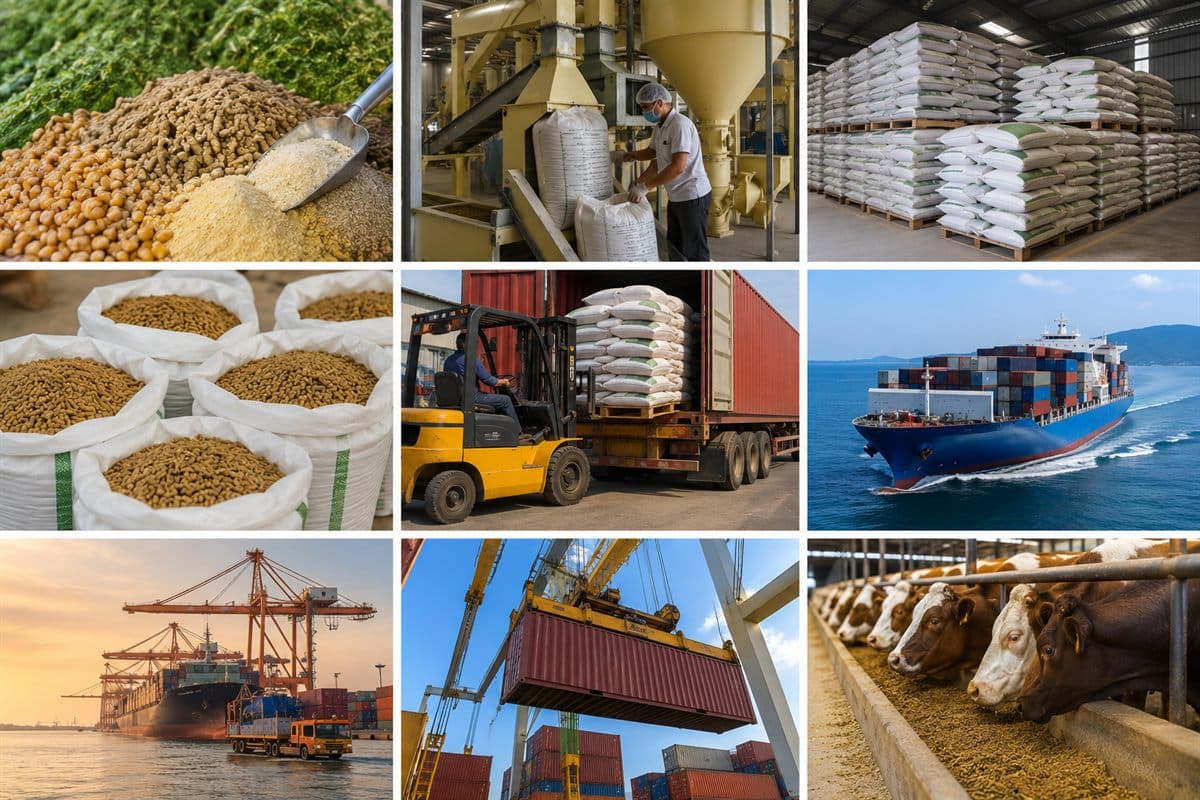
How to Export Cattle Feed from India — Documents, Buyers, Packaging & Container Loading
Export cattle feed from India — documents, buyer sourcing, payment terms, packaging, container loading, and common mistakes to avoid.
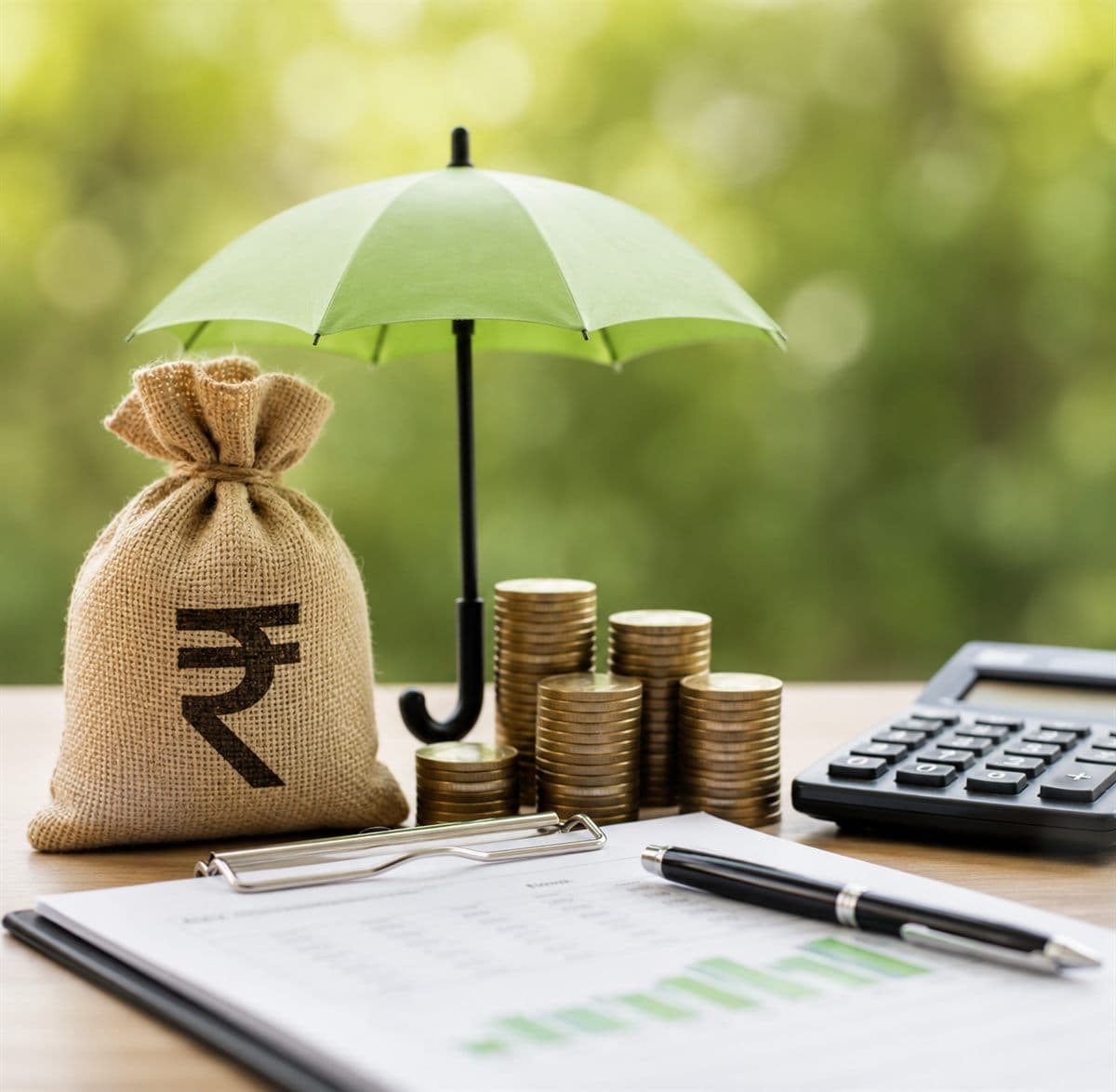
Cattle Insurance in India — Schemes, Premiums & Claim Process (2026)
Complete guide to cattle insurance in India — government schemes, premiums (2.5-4.5%), subsidies up to 90%, claim process, and how to apply.
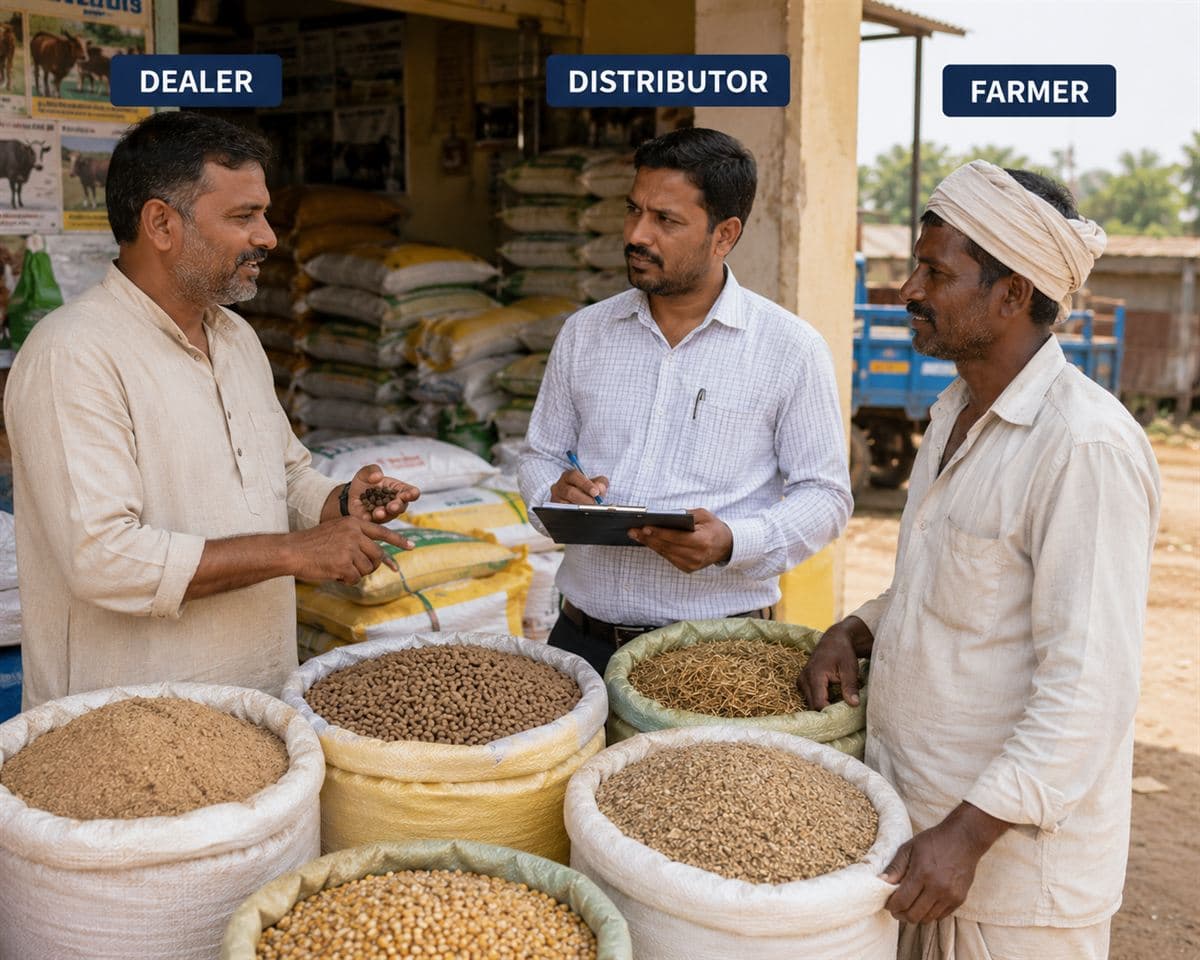
How Cattle Feed is Sold in India — The 5 Distribution Channels Explained
How cattle feed actually moves from factory to farmer in India — dealers, BMCs, distributor warehouses, schemes, and in-bag farmer gifts explained.