How Cattle Feed is Sold in India — The 5 Distribution Channels Explained
By Parv Badjatiya · Published Sat May 23 2026 00:00:00 GMT+0000 (Coordinated Universal Time) · Updated Sat May 23 2026 00:00:00 GMT+0000 (Coordinated Universal Time)
If you walk into any small dairy in rural India and pick up the bag of cattle feed sitting in the corner, you'll usually find no real explanation of how it got there. The bag has a brand. It has a price. It has feeding instructions. What it doesn't tell you is the journey: factory → distributor → dealer → sub-dealer → farmer, and the dozen decisions that shape what the farmer finally pays.
The Indian cattle feed trade is bigger than people realise. It moves several million tonnes of compound cattle feed a year, supports tens of thousands of dealerships, and runs on a mix of cash, credit, milk, and goodwill. This article is about how that actually works — written for anyone thinking of entering the trade, anyone already in it who wants the full map, and farmers who want to understand why their bag costs what it costs.
There are essentially six ways cattle feed reaches the farmer in India. The first four are distribution structures; the last two are commercial practices that sit on top of all of them.
The numbers cited throughout this article — dealer margins, truck freight costs, distributor warehouse capacities, and the like — are based on industry observation across multiple states and brands. They are indicative ranges, not fixed quotes. Specific figures vary by brand, season, state, and year.
Channel 1 — The classic dealer-to-sub-dealer chain
This is the backbone. Every major Indian cattle feed brand runs some version of it.
It looks like this:
Manufacturer → Dealer → Sub-dealer → Farmer
The manufacturer appoints a primary dealer in a town or district. That dealer takes large quantities — usually 5 to 50 tonnes a month, sometimes more — at a wholesale rate. The dealer then breaks that volume down to sub-dealers in surrounding villages. Sub-dealers are typically smaller shops, sometimes part of an agro-input store or a kirana that's added cattle feed alongside other products. The sub-dealer is the one who actually sees the farmer.
A few things farmers and outsiders rarely realise about this layer:
- Margins are thin. A primary dealer typically earns ₹15 to ₹40 per 50 kg bag depending on brand and region. Sub-dealers earn ₹10 to ₹25. That's why volumes matter so much — you do not get rich on per-bag margins, you survive on turnover.
- Working capital is the real bottleneck. Most farmers buy on credit, sometimes paying 30 to 60 days later when they get their milk payment. The dealer has to fund that gap. A dealer doing 100 tonnes a month is often carrying ₹15 to ₹25 lakh in unrecovered farmer dues at any given time.
- Brand exclusivity varies. Some manufacturers demand exclusivity (dealer sells only their brand); others happily accept multi-brand dealers. The exclusive ones usually give better margins, the multi-brand ones give wider product choice. Both work.
The dealer-sub-dealer chain is the oldest model in the Indian feed trade and it's still the dominant one in most states, especially for legacy brands.
Channel 2 — The milk-barter system through BMCs
This is the most uniquely Indian channel and one of the most efficient. It works through bulk milk coolers — the small chilling centres that dot every dairy belt.
Manufacturer → BMC operator → Farmer (exchange: cattle feed for milk)
Here's how it runs. A BMC operator is essentially a milk aggregator: dozens of small farmers bring their morning and evening milk to him, he chills it, and a truck from a dairy or co-op picks it up. The farmer is paid for the milk a few weeks later.
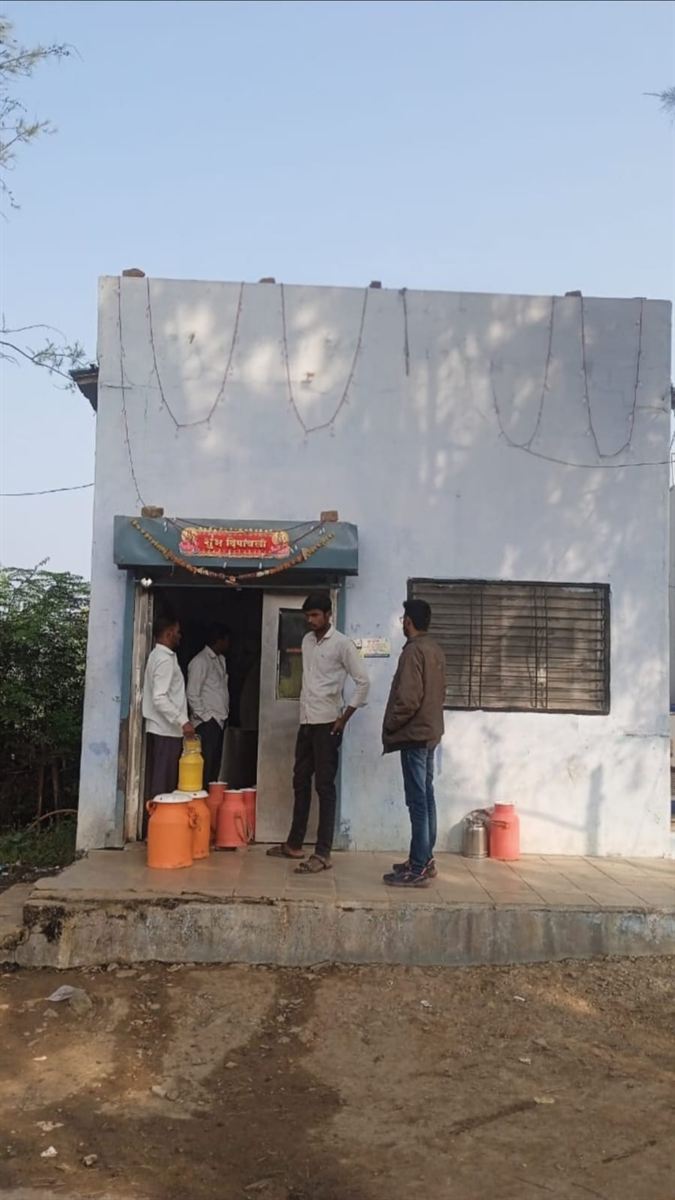 A village BMC in operation — farmers bring their morning and evening milk in steel cans, the operator chills it, and a tanker collects it daily. The same BMC often serves as the cattle-feed distribution point for its supplier farmers. Original photograph.
Many BMCs take cattle feed delivery from a manufacturer on credit. They then issue bags of feed to the same farmers who are supplying milk, and deduct the cost of the feed from the farmer's milk payment when it comes through.
For everyone involved this is a clean arrangement:
- The farmer doesn't need cash on hand to buy feed. Feed comes against milk that's already being delivered.
- The BMC operator earns a small margin on the feed plus stronger loyalty from his farmer suppliers — they won't sell milk to a competing BMC if they've got open feed credit with him.
- The manufacturer gets a predictable, recurring channel with low default risk (because the BMC controls the milk payment).
- The dairy or processor at the top of the chain benefits because farmers using compounded feed give better milk quality and quantity than farmers on home-mixed rations.
This channel dominates in states with strong cooperative dairy networks — Maharashtra, Gujarat, Karnataka, Andhra Pradesh, Punjab — and is growing as more BMCs adopt it. It bypasses the dealer chain entirely.
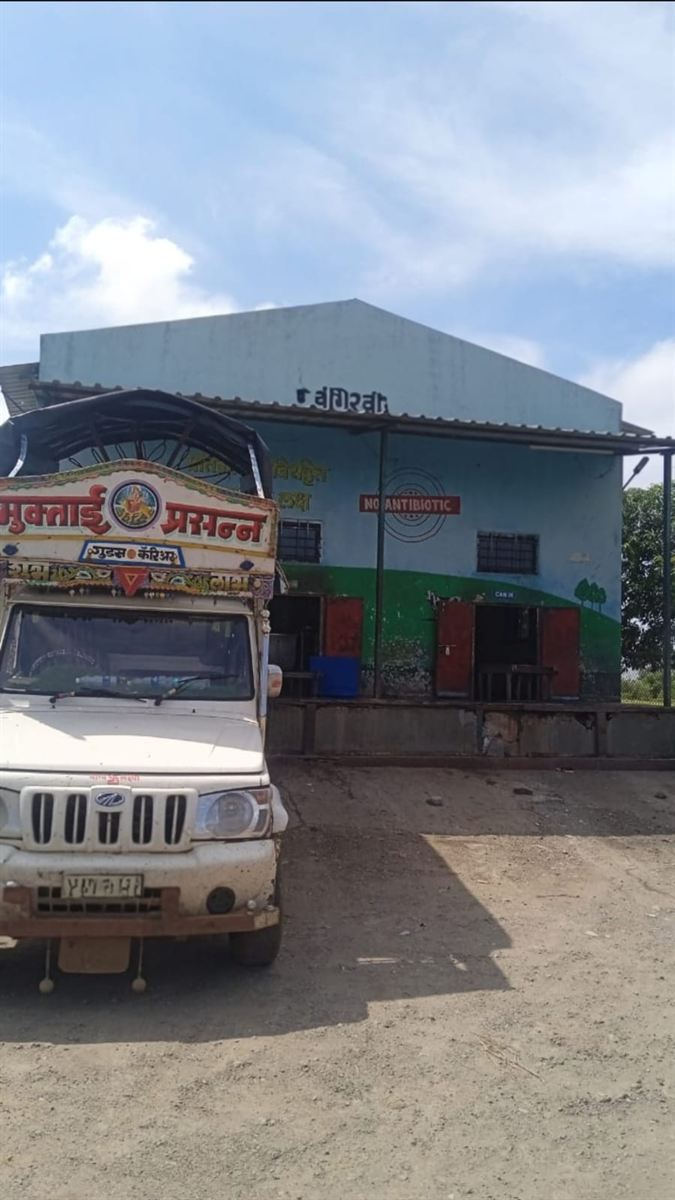 A larger regional BMC / chilling centre — one tier above the village BMCs, consolidating milk from multiple villages before it goes to the processor. The 'NO ANTIBIOTIC' wall messaging reflects the increasingly strict residue-testing standards that Indian milk now has to meet. Original photograph.
Channel 3 — Direct local sales near the factory
This one is small but worth understanding.
Manufacturer → Farmer (direct, at the factory gate)
A handful of farmers live close enough to a feed factory that they pick up bags directly from the plant. Manufacturers usually allow this because it's friendly local relations and the volume is too small to disrupt the dealer network.
Two characteristics of this channel:
- Price is usually higher than the dealer rate. Counterintuitive — you'd expect direct purchase to be cheaper. But manufacturers don't want to undercut their own dealers, so the direct-from-factory price is set above what the local sub-dealer charges. Some factories explicitly post the MRP at the gate and refuse to negotiate.
- Volume is tiny. We're talking maybe 1–3% of a factory's output going direct. It's not a real channel; it's an exception.
The reason this channel exists at all is goodwill — a factory that turns away its own neighbours has a problem in the local community.
Channel 4 — The distributor warehouse model
This is the channel that's been growing fastest over the last decade, especially among newer and mid-size brands.
Manufacturer → Distributor (warehouse) → Dealer → Sub-dealer → Farmer
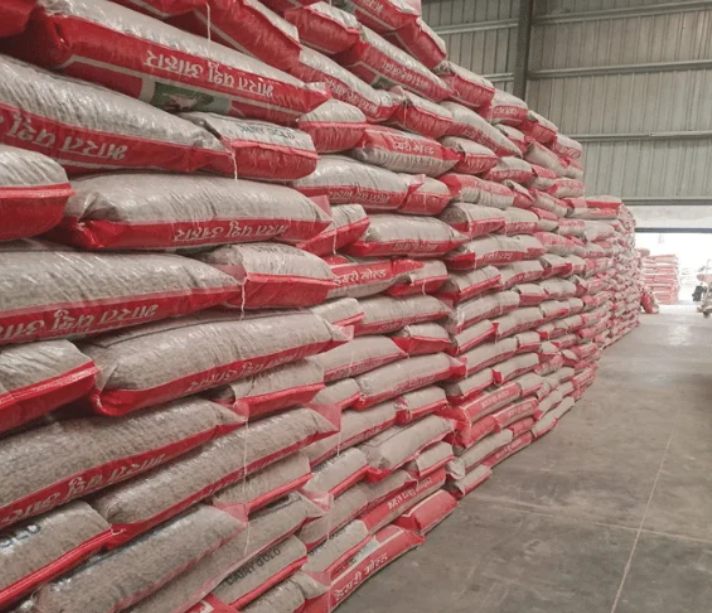 Stacked compound cattle feed bags at a regional distributor warehouse — the kind of stock-holding hub described in this channel. Original photograph.
A distributor is essentially a regional logistics partner. He owns or leases a warehouse, takes large stock from the manufacturer in one shipment (sometimes a full truck or rake), and then ships smaller quantities to dealers in his region as they need it.
Why this layer exists, when it seems to add cost:
- It collapses the manufacturer's logistics problem. Without a distributor, a factory in Maharashtra trying to supply dealers in Karnataka has to manage 40 small dealer accounts, 40 deliveries, 40 receivables. With a distributor, it's one account, one bulk shipment, one receivable. Hugely simpler.
- It improves stock availability. Dealers can order 5 or 10 tonnes from the distributor whenever they need it, without waiting for the next factory dispatch. The distributor holds inventory; the factory holds less.
- Sub-dealer direct supply. Increasingly, the dealer will ask the distributor to ship directly to his sub-dealer — saving a double-handling step. The dealer still earns his margin (it's accounted on the books), but the bags physically skip the dealer's premises. This is a quietly important efficiency.
The distributor typically earns ₹10 to ₹30 per bag. The economics for the distributor only work at high volume — usually 50 to 200 tonnes per month minimum — because the per-bag margin is small.
Channel 5 — The scheme economy
This isn't a fifth distribution channel exactly; it's the incentive layer that sits on top of the four channels above and makes them actually run.
Every major Indian cattle feed manufacturer runs schemes targeted at dealers and sub-dealers. The structure is almost always the same: hit a volume number, get a reward.
A typical scheme might look like:
- Sell 1,000 bags in a month → win a smartphone or kitchen appliance
- Sell 5,000 bags in a month → win a two-wheeler
- Sell 20,000 bags in a quarter → win a four-wheeler
- Sell the highest volume of the year nationally → an overseas trip with the manufacturer's senior team
These schemes shape dealer behaviour more than retail margins do. A dealer who is at 850 bags on the 25th of the month with a 1,000-bag target will push very hard to sell the last 150 bags, often offering customers an extra discount out of his own margin just to hit the gift threshold. From the manufacturer's side, this is exactly the point — they're paying a fixed gift cost in exchange for a guaranteed sales push at the end of every cycle.
Schemes also create dealer loyalty. A dealer who has won a car from Brand X for three years running is reluctant to switch even when Brand Y offers slightly better terms. It becomes more than business — it becomes identity.
The trade-off, and a fair criticism: schemes can incentivise dealers to push volume even when the local market isn't really absorbing it, leading to dealer-stuffing (inventory parking with farmers on extended credit) and downstream quality complaints. The well-run brands manage this carefully; the poorly-run ones don't.
Channel 6 — In-bag gifts to the end farmer
The last commercial practice is the simplest. It's also the most underrated.
When a brand wants to win over the actual farmer — not the dealer, not the BMC, but the person feeding the cow — they put a small free item inside the bag. Soap. A keychain. A small calendar. Occasionally a more substantial gift like a small steel container or a basic torch.
This sounds trivial but the psychology is real. A farmer opens the bag, finds a free bar of soap, and gives the brand a small mental tick. Repeated across millions of bags, that small tick is what builds brand preference at the village level — a level where TV ads don't reach and where Google can't show banner ads.
The economics: a manufacturer can include a ₹5 to ₹15 gift inside a bag that they're selling for ₹1,200 to ₹1,800. It's less than 1% of the bag price. The lift in repeat purchase across a year more than pays for it.
The competitive dynamic of who-puts-what-in-the-bag has become its own quiet arms race. Some brands have moved to mini sample bags of supplements (mineral mixture, salt brick, an immunity booster) instead of unrelated items like soap — turning the in-bag gift into something useful for the cattle, not just the farmer's bathroom.
What this all means for prices
A bag of cattle feed that retails at ₹1,500 in a village does not contain ₹1,500 worth of grain. The breakdown roughly looks like:
- Raw materials (the maize, soybean meal, oilseed cakes, DORB, wheat bran, molasses, urea, mineral mix): ₹950–1,100
- Manufacturing — energy, pellet die wear, packaging, labour, factory overhead: ₹130–180
- Logistics — factory to distributor, distributor to dealer, dealer to sub-dealer: ₹80–120
- Distributor margin: ₹15–30
- Dealer margin: ₹15–40
- Sub-dealer margin: ₹10–25
- Schemes and in-bag promotional cost amortised: ₹15–30
- Manufacturer's own profit: ₹60–120
The trade margin layer (distributor + dealer + sub-dealer + schemes + in-bag) collectively comes to roughly ₹70 to ₹140 per bag — about 5 to 10% of the retail price. That's the price of getting a 50 kg bag of compounded nutrition into a village 400 km from the factory, with multi-tier credit support along the way.
When farmers complain that "feed has become so expensive," the actual driver is almost always the raw materials line moving — see our daily raw material prices page for the live numbers — not greedy middlemen taking more. The trade margin layer is remarkably stable; raw materials are not.
Common business challenges in the cattle feed trade
If the trade flows look clean on paper, the day-to-day reality is messier. Anyone in this business — manufacturer, distributor, dealer, sub-dealer, or BMC operator — runs into the same five recurring problems. Understanding them is the difference between a profitable five years and a quietly bleeding business.
Delayed farmer payments
This is the single biggest pain point in the whole chain. Most farmers buy on credit: feed today, payment after the next milk-collection cycle, sometimes 30 to 60 days later, sometimes longer in lean months. When milk yields drop in summer, when a buffalo dries off, or when a household has a wedding to pay for, farmer payments slip further.
For a sub-dealer doing 100 bags a week at ₹1,500 each, every additional 15 days of delay locks up ₹2.25 lakh of working capital. The dealer above him sees the same pattern multiplied across 20 sub-dealers. Up the chain, the distributor and manufacturer are facing the same compounding lag. The whole system is essentially financing the farmer's milk cheque.
The well-run dealerships handle this with a simple discipline: limit credit per farmer to two weeks of his expected milk income, refuse to ship more bags until the previous lot is partly settled, and never let any single farmer's open balance exceed a fixed ceiling. The badly-run ones extend credit blindly, look at fat sales numbers for two years, and quietly fold in year three when the receivables turn into bad debt. This is also why dairy operators with cattle insurance (see our cattle insurance guide) are easier to extend credit to — a covered animal protects both the farmer and the lender if the cow dies mid-cycle.
Seasonal demand swings
Demand is not flat across the year. It swings sharply with the dairy calendar:
- Peak (October to February): Cool weather, post-monsoon green fodder is plentiful, milk yields are at their annual peak, and demand for concentrate feed is high.
- Trough (March to May): Heat stress kicks in, milk yields drop 15–30%, animals eat less, and concentrate demand softens. Some BMCs see feed throughput halve in deep summer.
- Erratic (June to September): Monsoon volatility means some weeks demand is flat, others spike when green fodder is washed out.
Manufacturers plan production calendars around this — they cannot run flat output year-round without massive warehousing. Dealers plan inventory cycles. Distributors plan working capital. The seasonal swing is the silent rhythm everyone in the trade lives by.
Transport cost volatility
A 25-tonne truck moving feed 600 km from a factory to a distributor warehouse costs between ₹35,000 and ₹65,000 depending on the season, diesel price, and route. That's ₹70 to ₹130 per 50 kg bag in pure transport. Add the second leg from distributor to dealer and you're at ₹100 to ₹180 per bag in logistics — a meaningful slice of the trade margin layer.
Diesel price increases get absorbed mostly by the manufacturer in the short term because retail prices cannot be revised every week. Sustained diesel rises eventually flow through to higher MRPs, but with a lag of weeks to months. In that gap, manufacturer margins compress.
The other transport problem is round-trip empty kilometres. A feed truck arriving in a remote dairy belt cannot easily find a return load. That empty leg is built into the freight quote, which is why feed delivered to states far from production hubs (north-east India, parts of Tamil Nadu and Kerala) carries a premium.
Raw material price volatility
The single biggest profitability lever for any cattle feed manufacturer is raw material cost. A 10% jump in maize or soybean meal prices can erase the entire manufacturing margin overnight. Recent years have seen:
- Maize prices swing 20–30% within a single quarter
- Soybean meal prices double during global tightness (most recently in mid-2026)
- DDGS prices spike when ethanol policy changes
- Oilseed cake prices move with the underlying oil market more than with feed demand
Smart manufacturers hedge this by:
- Long-term raw material contracts with mandis or processors for 3–6 month visibility
- Flexible formulation that lets them substitute one protein source for another when prices shift (e.g. replacing soybean meal with DDGS or cotton seed DOC when soy spikes)
- Inventory buffers — holding 30 to 60 days of stock so a sudden price spike doesn't force an immediate retail price hike
The retail price layer is too sticky to absorb daily volatility. Manufacturers therefore quietly carry the swing, and that's why understanding the daily raw material price trend matters more than any single day's quote — what the trade really watches is the direction and pace of change, not the absolute number.
Counterfeit and substandard feed
This is the dirty secret of the Indian feed trade. In high-volume markets, especially during peak demand months, fake or substandard feed appears.
The patterns vary:
- Outright fake — bags filled with bran, broken grain, and a dye to mimic the colour of a known brand, sold under a counterfeit label that looks like the genuine product.
- Adulterated genuine — manufacturer-original bags that have been opened, partially substituted with lower-quality material, and re-sealed by a dishonest dealer.
- Substandard but labelled correctly — a small, lesser-known brand selling 12% crude protein feed while the bag claims 20%. Technically not counterfeit, but consumer fraud.
The Bureau of Indian Standards (BIS) IS 2052 specification for compound cattle feed was supposed to police this through mandatory certification. The Delhi High Court ruling in Godrej Agrovet v. FSSAI (April 2026) struck down FSSAI's attempt to make BIS certification mandatory for cattle feed, leaving the quality-assurance landscape in a transition state — BIS standards are voluntary again until the Central Government issues a fresh notification through the proper BIS Act route.
For the farmer this means the bag label and the actual content can diverge sharply, and the only practical defences are:
- Buy only from known dealers with reputation to protect
- Ask for the Certificate of Analysis (CoA) for each batch
- Reject any bag where the seal looks tampered or the colour, smell, or texture is wrong
- Run an occasional independent lab test (some district veterinary universities will do this for ₹500–₹1,500 per sample) if you're a large enough farm to justify the cost
For dealers, the defence is the same — buy only from genuine manufacturer dispatch channels, refuse "discount stock" of unknown origin, and protect your own brand by being the one whose bags farmers can trust.
How this knowledge helps you
If you're thinking of entering this trade as a dealer or sub-dealer, the realistic profile is: you need 10 to 30 lakh in working capital to start, a relationship with at least one major manufacturer, godown space in a high-traffic location, and the patience to spend the first 18 months mostly chasing receivables rather than counting profits. Margins are thin; turnover is everything.
If you're a distributor, you need real warehouse capacity (typically 500 to 2,000 tonnes), the ability to take large bills (₹50 lakh to ₹2 crore in inventory), the financial standing to give 30-day credit to dealers below you, and the logistics to ship reliably across your region. The brands chase distributors more than the other way round — but only well-run distributors with clean cashflow.
If you're a manufacturer, the channel you build determines your scale ceiling. Direct-to-farmer doesn't scale. Dealer-only works regionally. BMC-based works in dairy belts. Distributor-based is what every brand growing past one state ends up adopting.
If you're a prospective dairy farmer evaluating whether to even start the operation that will consume all this feed, see our companion guide on how to start a dairy farm in India — costs, profit math, and government schemes — before committing capital.
If you're an existing farmer, two practical things from all this:
- Don't always trust the sub-dealer's "best brand" recommendation. The sub-dealer's brand preference is usually shaped by which manufacturer is currently running the biggest scheme at his level, not which feed is best for your specific cow. Read the bag label, check whether the brand voluntarily carries BIS certification (see our compound cattle feed guide for what to look for on the label), and ask for the Certificate of Analysis.
- The price you pay is shaped less by farmer-side bargaining and more by the channel you buy from. A direct factory-gate purchase is typically more expensive, not less. A purchase through a BMC against milk is usually cheaper because it bypasses the dealer-sub-dealer markup.
The bigger picture
The Indian cattle feed trade is more sophisticated than outsiders give it credit for. It runs on credit cycles, milk-deduction arrangements, dealer schemes, and small psychological levers like in-bag soap — none of which are visible from the outside, all of which are essential to making sure a small dairy farmer in a remote village gets a 50 kg bag of nutrition every two weeks, on time, on credit, in any season.
It's not perfect. The credit cycle creates working-capital stress at every layer. Dealer-stuffing happens. Some BMC operators game the milk-deduction. Some manufacturers run schemes irresponsibly. But the system, taken as a whole, is what allows India to be the world's largest milk producer despite being a country of millions of small holdings rather than a few thousand mega-farms.
If you understand the system, you can work within it. If you're trying to disrupt it — as several agritech startups have tried over the last decade — you ignore it at your peril.
Related articles
Cattle Insurance in India — Schemes, Premiums & Claim Process (2026)
Complete guide to cattle insurance in India — government schemes, premiums (2.5-4.5%), subsidies up to 90%, claim process, and how to apply.
Liquid Molasses in Cattle Feed — Specs, Inclusion Rate, Tenders & Sourcing in India
Liquid molasses in Indian cattle feed pellets — Grade A specs, Brix and moisture, inclusion rate, tender sourcing, and the 2026 UP shortage.
How to Export Cattle Feed from India — Documents, Buyers, Packaging & Container Loading
Export cattle feed from India — documents, buyer sourcing, payment terms, packaging, container loading, and common mistakes to avoid.