Camel Feeding Guide for Indian Camel Owners
By Parv Badjatiya · Published Mon May 18 2026 00:00:00 GMT+0000 (Coordinated Universal Time) · Updated Mon May 18 2026 00:00:00 GMT+0000 (Coordinated Universal Time)
Why camel feeding is different from cattle feeding
A camel is not just a big cow. It is built for the desert. Camels can live and work in conditions that would kill a cow or buffalo. This means the way you feed a camel is also different.
Camels in India are mainly found in Rajasthan (Bikaner, Jaisalmer, Jodhpur, Barmer, Pali) and Kutch in Gujarat. The most common breeds are Bikaneri, Jaisalmeri, Mewari, Kachchhi, and Marwari. All Indian camels are dromedaries (single-hump camels).
This guide tells you, in simple language, how much to feed your camel, what to give it, and what to avoid.
The main difference: camels eat less but can eat anything
A camel of 500 kg eats only 25 to 30 kg of green food per day. A cow of the same weight eats more — about 30 to 40 kg of green fodder. But camels make better use of what they eat.
| Animal (500 kg) | Daily fodder needed | What it can eat |
|---|---|---|
| Camel | 25–30 kg green | Tree leaves, thorny bushes, dry grass, almost anything |
| Cow / Buffalo | 30–40 kg green | Mostly grass and cultivated fodder; rejects thorny plants |
This is the key fact: a camel can eat poor-quality food and still live well. A cow on the same food would lose weight and stop giving milk.
What camels naturally eat in India
Camels are browsers. This means they prefer leaves and branches from trees and bushes rather than grass on the ground. The most common plants Indian camels eat:
| Plant | Where found | Notes |
|---|---|---|
| Khejri tree (Prosopis cineraria) | Across Rajasthan and Kutch | The most important camel food in Rajasthan |
| Ker bush | Desert and semi-desert | Camels love it |
| Neem leaves | All over India | Good in moderation |
| Babool / Kikar (Acacia) | Across north and west India | Camels eat even the thorns |
| Bordi tree | Rajasthan/Gujarat | Sweet leaves |
| Pala bush | Desert | Common camel browse |
| Aak / Calotropis | All over India | Camels can eat this even though it is toxic to cattle |
| Sewan grass | Rajasthan desert | Excellent dry-season grass for camels |
| Maize / jowar / bajra stalks | Wherever grown | Good when available |
Free-grazing in rangeland gives a camel most of what it needs. But when grazing is poor, or the camel is working hard, or the female is producing milk, you need to add extra feed.
Simple daily ration for a 500 kg adult camel
This is a basic daily ration for a normal adult camel, not giving milk, not doing heavy work:
| Feed type | Amount per day |
|---|---|
| Green fodder + tree leaves (free grazing or cut-and-carry) | 25–30 kg |
| Dry fodder (bajra straw, wheat straw, jowar kadbi) | 3–5 kg |
| Concentrate feed (only if grazing is poor) | 0–1 kg |
| Mineral mixture | 100–150 g |
| Salt | 30–50 g |
| Clean water | 30–60 litres |
For a working camel (pulling cart, riding) add 1–2 kg of concentrate per day.
For a milking female camel, see the section below.
Feeding a milking female camel
Female camels (called she-camels or "untini") produce milk for 12–18 months after calving. Indian camel milk is now sold at premium prices (₹100–300 per litre) because:
- High in vitamin C
- Lower fat than cow milk (about 3%)
- Believed by many to help with diabetes
- In demand from city consumers
A milking she-camel needs more food. Daily ration for a 500 kg camel giving 5–10 L of milk per day:
| Feed type | Amount per day |
|---|---|
| Green fodder + tree leaves | 30–35 kg |
| Dry fodder | 4–5 kg |
| Concentrate feed | 2–4 kg |
| Mineral mixture | 150–200 g |
| Salt | 40–60 g |
| Water | 60–90 litres |
For very high-yielding camels (10+ L/day), increase concentrate to 4–6 kg/day.
A simple concentrate mix for camels
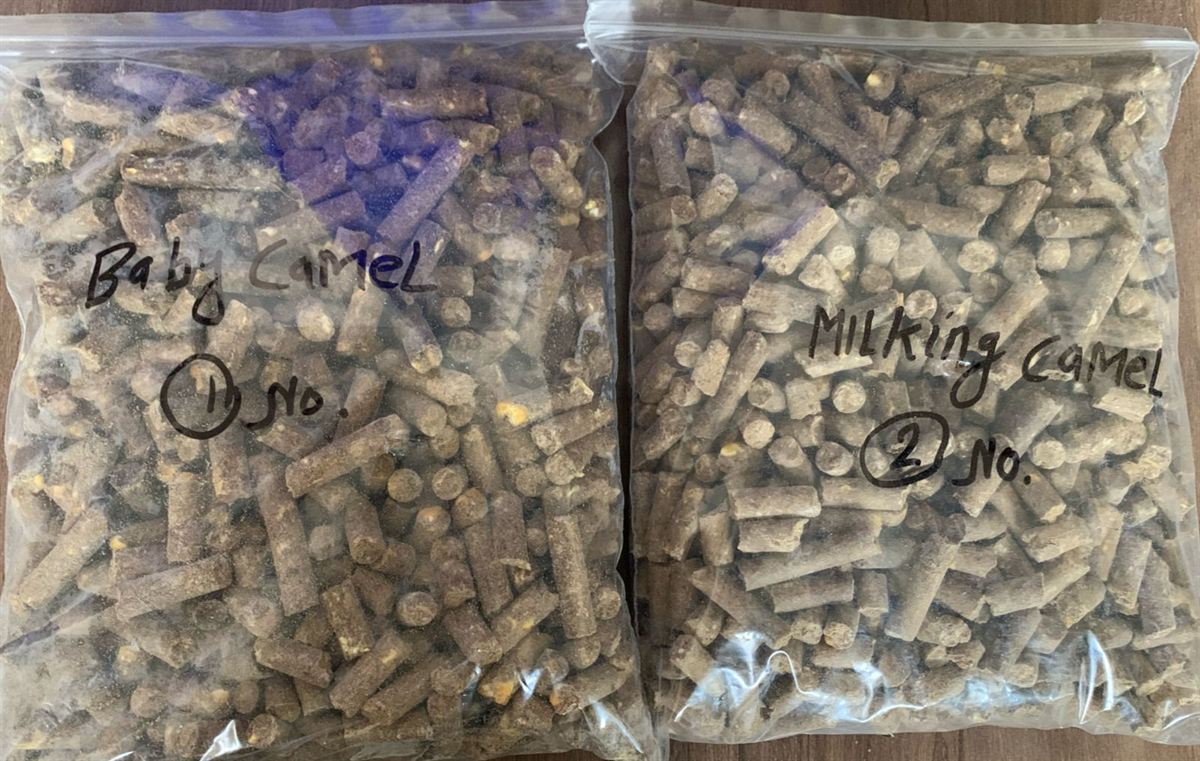 Manufactured camel feed pellets in two life-stage variants — 'Baby Camel No. 1' for young dromedaries and 'Milking Camel No. 2' for lactating she-camels. The young-camel pellets are smaller and carry visible coloured mineral and vitamin fragments; the milking-camel pellets are larger, denser, and formulated for the energy demand of milk production. Manufactured stage-specific camel feed is far less common than for cattle but is now available in Rajasthan and Gujarat. Original photograph.
If you cannot buy ready compound feed, mix your own concentrate. A good camel concentrate mix:
| Ingredient | Percentage |
|---|---|
| Bajra or maize (cracked) | 30% |
| Groundnut cake or mustard cake | 20% |
| Wheat bran or wheat bran | 15% |
| Gram chuni (chana churi) | 15% |
| Molasses | 10% |
| Cotton seed cake | 8% |
| Mineral mixture | 1.5% |
| Salt | 0.5% |
| Urea | 0% (never) |
Like for calves and sheep, never put urea in camel feed. Camels can get sick from urea even though they are big animals. Their stomach is different from cattle.
Why camels need extra salt and minerals
Camels need more salt than cattle because:
- They sweat in hot weather (cattle don't sweat much)
- They eat dry fodder which is low in sodium
- They drink less water than you might expect
- Their milk contains some salt
Always give:
- 30–50 g of common salt per day (50–60 g for milking camels)
- Or a salt block (white salt or rock salt) that the camel can lick
- 100–200 g of mineral mixture per day
Without enough salt, the camel eats less and gives less milk.
How much water does a camel really need?
People say camels don't need water. This is partly true — they can go many days without water. But for best health and milk production, give water every day.
| Condition | Daily water need |
|---|---|
| Cool winter day | 20–30 litres |
| Normal day | 30–60 litres |
| Hot summer day | 60–80 litres |
| Milking camel in summer | 80–100 litres |
Always give clean, cool water. Dirty water reduces intake and can cause health problems.
How camels are different from cattle in digestion
This is for understanding, not for daily decisions:
| Feature | Camel | Cow / Buffalo |
|---|---|---|
| Stomach chambers | 3 (technically "pseudo-ruminant") | 4 (true ruminant) |
| Daily food intake | 2–2.5% of body weight (DM) | 2.5–3.5% of body weight (DM) |
| Best food source | Tree leaves, browse, dry plants | Grass, fresh green fodder |
| Water need | Low (can go days without) | High (daily) |
| Heat tolerance | Very high | Moderate (HF cross is low) |
| Fasting ability | Days without harm | Days lose condition fast |
The bottom line: a camel is a survivor. It can do well on food that cattle would refuse.
Feeding by camel use
Different camels need different feeding:
Resting / pasture camel (not working, not milking)
- Free grazing for 6–8 hours per day
- 3–5 kg dry fodder in the evening
- Salt and mineral mixture
- Water once or twice a day
This is the simplest, cheapest feeding. Most family camels are kept this way.
Working camel (pulling cart, carrying load, riding)
- 25–30 kg green fodder/browse
- 5 kg dry fodder
- 1–2 kg concentrate
- 50 g salt
- 150 g mineral mixture
- 60+ L water
Concentrate is needed because the camel uses extra energy for work.
Milking she-camel
- 30–35 kg green fodder/browse
- 4–5 kg dry fodder
- 2–4 kg concentrate (more for high producers)
- 60 g salt
- 200 g mineral mixture
- 80–100 L water
The concentrate and mineral mixture support milk production. Without these, milk yield drops within 2–3 weeks.
Camel calf (under 1 year)
- Mother's milk (first 4–6 months main food)
- 5–8 kg green fodder by 6 months
- 0.5 kg calf starter feed (without urea) by 4 months
- Gradually introduce dry fodder
- Wean at 8–12 months when eating 2 kg+ solid feed per day
Camel calves grow slower than dairy calves. Don't rush weaning.
Pregnant she-camel
Last 3 months of pregnancy (camel pregnancy is 12–13 months total):
- Increase concentrate by 1–1.5 kg/day above maintenance
- Make sure mineral mixture is adequate
- Don't allow her to lose body condition
Common Indian camel breeds and what to expect
| Breed | Region | Adult weight | Daily milk |
|---|---|---|---|
| Bikaneri | Bikaner, Rajasthan | 450–600 kg | 4–10 L/day |
| Jaisalmeri | Jaisalmer, Rajasthan | 500–650 kg | 4–8 L/day |
| Mewari | South Rajasthan | 400–550 kg | 6–12 L/day (highest milking) |
| Kachchhi / Kutchi | Kutch, Gujarat | 450–600 kg | 4–8 L/day (also swims in sea water) |
| Marwari | Rajasthan | 400–550 kg | 3–6 L/day (more work-type) |
| Mewati | Haryana / Rajasthan border | 400–550 kg | 4–7 L/day |
The feeding amounts above apply to all breeds. Larger camels need a bit more food; smaller need less.
What NOT to feed a camel
Some things are dangerous or wasteful for camels:
- Urea — never. Even adult camels can get urea poisoning.
- Sudden large amounts of grain — causes acidosis, same as cattle
- Mouldy feed — same aflatoxin risk as cattle
- Very young green fodder in big amounts — causes loose dung
- Standing water (stagnant) — risk of disease
- Old/spoiled mineral mixture — vitamins lost, less effective
Tips for healthy camel keeping
- Let the camel graze freely when possible — 4–6 hours of browsing in rangeland gives the camel exercise, sunshine, and varied food
- Provide shade in summer — camels handle heat well but milking camels produce more in cool conditions
- Provide shelter from cold winter nights — newborn camels especially
- Trim hooves regularly — overgrown hooves cause lameness
- Give mineral mixture every day — most cheap, most effective health investment
- Watch for weight loss — a thin camel is a sick camel; investigate immediately
- Vaccinate against common diseases — consult a local veterinarian
Why camel keeping is becoming valuable again
For many years, Indian camel numbers were falling. But in the last 10 years, camel milk has become valuable:
- Camel milk price: ₹100–300 per litre at the city retail level
- Cow milk price: ₹40–55 per litre
- Camel milk is sold to specialty dairies, ayurvedic markets, and exporters
- Diabetic patients are recommended camel milk by some doctors
A she-camel giving 8 L/day at ₹150/L farm gate earns ₹1,200/day — more than 3× the milk income of a similar-yielding cow. Many Rajasthan and Kutch families are now looking again at camels as a profitable livestock option.
Conclusion
Feeding a camel well is simpler than feeding a cow. Give 25–30 kg of green fodder or tree leaves, 3–5 kg of dry fodder, salt and mineral mixture daily, and clean water. For working camels or milking she-camels, add 1–4 kg of concentrate feed without urea. The Indian camel is built to survive on what the land offers — your job is just to make sure she gets enough of it, plus the salt and minerals she needs.
If you treat your camel well, she will work for you for 15–20 years and give 8–12 calves in her lifetime. In return, all she needs is good fodder, fresh water, and respect for her desert-evolved nature.
Frequently asked questions
How much food does a camel eat in one day?+
What grows in the desert that camels can eat?+
How much water does a camel drink?+
What concentrate feed is best for a milking camel?+
Do camels need salt?+
Which camel breeds are common in India?+
Related articles
Ketosis in Dairy Cattle: Causes, Detection & Prevention
Ketosis in Indian dairy cattle — clinical vs subclinical, BHB thresholds (1.2 / 3.0 mmol/L), BCS and transition-cow prevention, and treatment options.
Mastitis in Dairy Cattle: Prevention, Detection & Treatment
Mastitis in Indian dairy cattle — clinical vs subclinical, SCC thresholds, NMC 5-point prevention, dry cow therapy, treatment, and the economic cost.
Monsoon Dairy Management: Protect Cattle, Feed & Milk Yield
Monsoon dairy management for Indian farmers — feed mould and aflatoxin control, mastitis prevention, hoof care, and a pre-monsoon checklist.