Corn Grits (Groat of Corn) in India — Specifications, Particle Size & Industrial Uses
By Parv Badjatiya · Published Wed May 27 2026 00:00:00 GMT+0000 (Coordinated Universal Time) · Updated Wed May 27 2026 00:00:00 GMT+0000 (Coordinated Universal Time)
Most farmers buying maize for cattle feed have never seen groat of corn (also called corn grits), but they're using a downstream by-product of it every time they buy a bag of compound feed containing maize DDGS. Corn grits sit upstream of much of the modern Indian compound feed industry — and almost nobody writes about them in English. This article fixes that.
What is groat of corn?
Groat of corn is coarsely cracked, dehulled and degermed maize. Think of a maize kernel: it has three parts.
- Hull (pericarp) — the outer fibrous skin
- Germ (embryo) — the small oil-rich kernel at the base that grows into a new plant
- Endosperm — the bulk of the kernel, mostly starch with a small protein component
Whole maize that goes directly into cattle feed contains all three. Corn grits are what's left after the hull and germ are mechanically separated out and the endosperm is broken into coarse particles between roughly 0.5 mm and 5 mm.
The result is a bright yellow-orange product that flows like sand, looks like a pile of small jagged corn fragments, and is much lower in fat than whole maize — because the germ (where almost all the fat lives) has been removed.
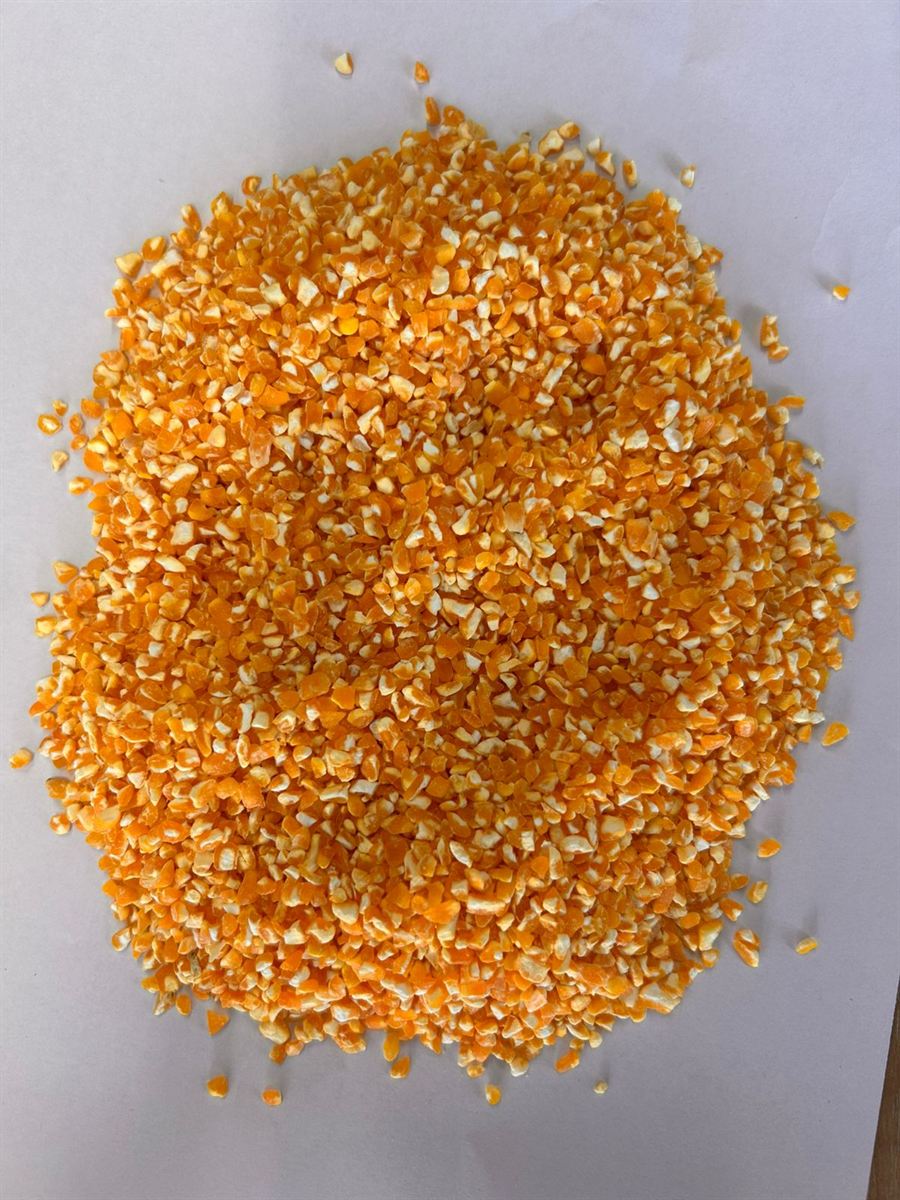 Corn grits (groat of corn) — coarsely cracked, dehulled and degermed corn endosperm. The bright orange-yellow colour comes from the carotenoid pigments in yellow maize. Original photograph.
How corn grits differ from related products
The Indian feed industry uses several different forms of processed maize and they're often confused. Here's the family map:
| Product | Particle size | Hull / germ | Typical use |
|---|---|---|---|
| Whole maize | Whole kernel | Both present | Direct cattle feed, poultry feed, compound feed |
| Cracked maize | 2–8 mm rough chunks | Both present | Cattle feed (better digestibility), calf feed |
| Corn grits (groats) | 1–5 mm controlled particles | Both removed | Ethanol, brewing, food, premium calf starter |
| Cornmeal | 0.5–1 mm | Hull removed, germ often retained | Cooking, baking |
| Corn flour | Below 0.5 mm | Both removed | Cooking, industrial |
| Corn starch | Below 0.1 mm pure starch | Pure endosperm fraction, refined | Industrial, pharma, food |
The two most important distinctions for the feed industry:
- Hull and germ are removed — so corn grits have less fat (and energy) than whole maize, but the starch is more accessible
- Particle size is controlled — not arbitrary like cracked maize; mills target specific size distributions for specific customers
The production process — dry milling
Corn grits are made in a dry-milling plant, distinct from the wet milling that produces corn starch. The dry-milling process is:
- Cleaning — the incoming maize is sieved, magnet-separated, and air-classified to remove dust, foreign material, broken kernels, stones, and metallic fragments
- Tempering — water is sprayed onto the cleaned grain to bring moisture to around 16–18%, then it sits for 1–4 hours. Tempering toughens the hull and softens the germ so they separate cleanly from the endosperm.
- Degerming — a degermer (essentially a high-speed mechanical separator with adjustable clearance) breaks the kernel and partially separates the germ and hull from the endosperm fragments
- Drying and cooling — the wet endosperm fragments are dried back down to 11–13% moisture (the storage-safe range)
- Sifting and grinding — a series of corrugated rolls and sieves grade the endosperm fragments into specific particle-size bands. The largest go to "coarse grits", medium to "regular grits", smaller fragments to cornmeal, finest to corn flour.
- Packaging — typically into 50 kg HDPE woven bags with inner liners, sometimes 25 kg for specialty grades
The germ and hull that come off the degermer are not waste — the germ goes to corn oil extraction (and the resulting cake to feed mills), the hull goes to bran/fibre markets.
Reading a real Certificate of Analysis
What does food-grade corn grits actually look like on paper? A typical CoA from an Indian dry-milling plant lists eight or nine parameters tested for every lot. Walking through them is the fastest way to understand what quality means in this category. The values below are from a real recent CoA dated July 2025 — representative of what a buyer in the Indian market should see on a compliant lot.
The parameters that matter, in order:
Moisture: 12.40% (specification 9.5–13.5%)
The single most important storage-stability number. Below 9.5% and the grits become brittle, dust-prone, and the starch starts to lose its slight cohesion. Above 13.5% and the product is at risk of mould growth — especially aflatoxin-producing Aspergillus flavus, the same risk that haunts every other corn-derived ingredient (see our aflatoxin article).
12.40% is comfortably inside the target band — adequate flowability, low spoilage risk.
Alcoholic Acidity: 0.072% (max 0.12%)
This is the rancidity / oxidation marker. As the small amount of residual fat in the grits oxidises over time, free fatty acids accumulate. Alcoholic acidity measures these free fatty acids extracted in alcohol.
A reading of 0.072% — well under the 0.12% ceiling — confirms the sample is fresh. A 60-day-old bag in good storage typically sits at 0.05–0.10%. Anything above 0.15% indicates over-oxidised or improperly stored stock.
Fat Content: 0.68% (max 2%)
This number is the proof of proper degerming. Whole maize is 4–5% fat (almost all of which lives in the germ). When degermed corn grits come in at under 1% fat, the degermer has done its job — the germ has been cleanly separated and shunted to the oil-extraction stream.
For ethanol producers and brewers, low fat is a positive: fat interferes with fermentation efficiency and can carry through to product flavour. For cattle nutrition, the same low fat means corn grits deliver more starch per kg than whole maize but less metabolic energy.
Heavy Filth: 0.01% (max 0.02%)
The contamination check — insect fragments, rodent hair, foreign animal matter. Anything above 0.02% is automatic rejection. At 0.01% the lot is clean.
Acid Insoluble Ash (AIA): 0.015% (max 0.05%)
Silica and sand contamination. Acid Insoluble Ash is the standard test for adulteration with sand, soil, or silica fillers (see our AIA glossary entry). At 0.015% the result is well inside the 0.05% ceiling — no adulteration concerns. For context, BIS limits AIA in compound cattle feed to 2.5%, so the corn-grits ceiling is 50× stricter because grits are sold into food and ethanol industries with higher cleanliness requirements.
Black Particle: 9 sq.in. (max 10 per 10 sq.in.)
The visual contamination check — burned grits, ergot bodies, mould-stained kernels, very dark foreign matter. Just under the ceiling at 9 — acceptable but on the boundary.
Particle size distribution
| Mesh size | Specification | This lot |
|---|---|---|
| Retained on 5 mm | 0–1% | 0.0% |
| Retained on 4 mm | 0–40% | 18.3% |
| Retained on 2 mm | 60–100% | 81.2% |
| Through pan (smallest fraction) | 0–2% | 0.5% |
Reading this: 0% of particles are larger than 5 mm, 18.3% are between 4–5 mm, 81.2% are between 2–4 mm, and 0.5% are finer than 2 mm. So the bulk of the grits sit in the 2–4 mm band, which is the sweet spot for ethanol fermentation, brewing, and most snack-extrusion processes.
Shelf life: 60 days
This is the commercial shelf-life claim. The actual chemical stability is longer (180+ days in optimum conditions), but the milling industry conservatively quotes 60 days because the alcoholic acidity climbs slowly through storage and 60 days is the window in which the lot reliably meets the 0.12% specification.
Packing: 50 kg bags
Standard commercial pack for industrial-scale buyers (ethanol plants, breweries, food processors). Smaller 25 kg packs exist for specialty calf-starter manufacturers but are less common.
Where corn grits actually get used in India
Five major use buckets, ranked by volume:
1. Ethanol production (the largest single use)
India's Ethanol Blended Petrol programme — run by the Ministry of Petroleum & Natural Gas and supported by maize procurement coordination through the Food Corporation of India — has driven massive demand for corn-based ethanol. Corn grits are the primary feedstock — they're sent through enzymatic hydrolysis (starch to glucose) and fermentation (glucose to ethanol) at distilleries.
The crucial downstream link: every tonne of corn grits that goes into ethanol fermentation produces roughly 300–350 kg of maize DDGS as a by-product. That DDGS is what shows up in compound cattle feed at our daily prices page. So the corn grits supply chain is upstream of much of the modern Indian compound feed industry — most cattle feed producers don't think about it that way, but it's true.
When global ethanol demand spikes or maize prices move, corn grits prices respond first, then DDGS prices, then compound feed prices.
2. Brewing
Indian breweries — both large national brands and craft microbreweries — use corn grits as an adjunct to malted barley. The low fat content of degermed grits is essential here because fat interferes with foam stability and beer haze. Grits typically replace 20–35% of the malted barley in mainstream lagers.
3. Human food
Several large categories:
- Extruded snacks — those bright orange/yellow corn puffs sold by every Indian snack brand start as corn grits going into an extruder under heat and pressure
- Breakfast cereals — flakes, puffs, and granola products
- Polenta and grits — for the high-end and HORECA markets
- Industrial bakery — corn grits as a textural ingredient in some breads and crackers
4. Premium calf starter feed (cattle feed niche)
This is where corn grits become directly relevant to the cattle feed industry as a finished raw material rather than as a DDGS precursor.
High-end calf starter manufacturers — making the kind of 22% protein, 4% fat, 4 mm pellet product we cover in our cattle feed stages and calf starter feed guide — sometimes include corn grits as 10–15% of the formulation. The advantages over whole or cracked maize for calf use:
- Higher digestible starch — the calf's undeveloped rumen handles starch better when it isn't trapped behind hull fibre
- Lower fat — calves can manage modest fat, but the variability of whole-maize fat can cause batch-to-batch performance variation
- Cleaner sensory profile — calves are pickier eaters than adults; the controlled appearance and consistent particle size of grits supports intake
- Longer shelf life — degermed grits at 0.7% fat resist rancidity much better than whole maize at 5% fat; calf starter often sits on dealer shelves longer than lactating feed
The cost penalty (₹30–40 vs ₹20–25 for whole maize) is justifiable for premium starters where ingredient quality drives long-term cow performance.
5. Pet food
A small but growing use — premium dog and cat food formulations use corn grits for the same reasons as calf starter (digestibility, cleanliness, sensory consistency).
Why this matters for the cattle feed industry
Three reasons every feed-industry person should understand corn grits even if they don't buy them directly:
1. Aflatoxin pathway. Any aflatoxin contamination in the corn that goes into grit production carries through to the DDGS by-product at roughly 3× concentration (the ethanol fermentation removes water and starch, concentrating non-volatile contaminants). A lot of corn grits at 30 ppb aflatoxin will produce DDGS at 60–90 ppb — exceeding the BIS 20 ppb limit for compound cattle feed. So the corn grit CoA matters even for feed-only buyers downstream.
2. Quality benchmark transfer. The CoA framework shown above — every-lot testing, defined specifications, alcoholic acidity, AIA, particle size distribution — is what the food and ethanol industries demand from their suppliers. The same discipline transferred to compound cattle feed manufacturing dramatically improves end-product quality. Forward-thinking feed mills are starting to ask their corn suppliers for CoAs of this depth.
3. Price signaling. Corn grit prices move 1–4 weeks before the equivalent move in DDGS, which moves before compound feed prices. Watching the corn grit price is a way to anticipate where compound feed costs will head in the next month.
Pricing in the Indian market
Indicative recent ranges:
| Product | Typical wholesale price |
|---|---|
| Whole maize | ₹20–25 / kg |
| Cracked maize | ₹22–27 / kg |
| Corn grits (food-grade) | ₹30–40 / kg |
| Corn grits (ethanol-grade, lower spec) | ₹26–32 / kg |
| Cornmeal | ₹28–35 / kg |
| Corn flour | ₹35–50 / kg |
Food-grade grits carry a premium for the tighter spec (lower AIA, lower fat, controlled particle size, supply-chain traceability). Ethanol-grade is slightly cheaper because the tolerance bands are wider.
Track today's underlying maize prices on our daily raw material prices page — corn grit prices typically sit at maize + ₹8–₹15 processing margin.
What to check when buying
For any commercial buyer of corn grits (ethanol plant, brewery, feed mill, snack manufacturer):
- Demand a CoA per lot — non-negotiable. Without a CoA, the bag is a black box.
- Check moisture first — anything above 13.5% is rejection territory regardless of price
- Check fat next — confirms proper degerming. Anything above 1.5% means germ has bled into the endosperm fraction
- Sample the particle size yourself — sieve a 1 kg sample through 5 mm, 4 mm, 2 mm sieves and verify the CoA values
- Open the bag and smell — fresh corn grits smell faintly sweet and grain-like. Sour, musty, or rancid smell = reject
- Check colour — bright orange-yellow indicates fresh degermed yellow corn. Pale or grey-tinted product means stale or improperly stored
The bigger picture
Corn grits are one of those invisible ingredients — the broader Indian dairy and feed industry consumes them indirectly, through DDGS, through high-end calf starter, through the ethanol industry that's reshaping rural maize demand. Understanding what they are, how they're made, what a real CoA looks like, and where in the value chain they sit, is part of understanding the modern Indian feed industry as it actually works.
Most of what's published about corn grits in English serves the food or brewing audiences. This article is the cattle feed industry's view of the same material — written so that any feed buyer, manufacturer, or curious dairy farmer can read it once and understand both the product and its broader role.
For the related downstream DDGS family that touches Indian cattle feed directly, see our Maize DDGS, Rice DDGS and Maize DOC article.
Related articles
Cattle Feed Stages Explained — Starter, Grower, Heifer, Pregnancy, Close-Up & Transition
Stage-by-stage guide to compound cattle feed in India — starter, grower, heifer, pregnancy, close-up & transition pellets (BIS Type-1, no urea, 25 kg).
Calf Starter Feed: Complete Guide from Birth to Weaning
Calf starter feed in Indian dairy — colostrum, milk feeding schedule, BIS Type-1 specs, why no urea for calves, weaning age, and common mistakes.
Liquid Molasses in Cattle Feed — Specs, Inclusion Rate, Tenders & Sourcing in India
Liquid molasses in Indian cattle feed pellets — Grade A specs, Brix and moisture, inclusion rate, tender sourcing, and the 2026 UP shortage.