Calf Diarrhoea (Scouring): Causes, Treatment & Prevention
By Parv Badjatiya · Published Mon May 18 2026 00:00:00 GMT+0000 (Coordinated Universal Time) · Updated Mon May 18 2026 00:00:00 GMT+0000 (Coordinated Universal Time)
Why calf scouring is the most dangerous problem on an Indian dairy
In the first month of life, more dairy calves die from scouring (diarrhoea) than from any other cause. It is the most common neonatal disease worldwide and a constant background risk on every Indian dairy. Even when it doesn't kill, scouring sets back growth, weakens the calf permanently, and makes the calf more vulnerable to later disease and slow development.
A critical insight that frames everything in this article: the diarrhoea itself is not what kills a calf. Dehydration and electrolyte loss kills the calf. The treatment priority is therefore not "stop the diarrhoea" but "replace the water and electrolytes faster than the calf is losing them." Every successful scour treatment is built on this principle.
This article walks through the four main causes of scouring, the symptoms that indicate the level of urgency, the practical treatment protocol using oral rehydration, and the six prevention practices that eliminate most scouring on Indian dairy farms.
The four main causes of calf scouring
Calf scouring is rarely from a single cause. Usually two or three factors combine — a calf weakened by inadequate colostrum, exposed to an infectious agent, in an unhygienic environment, with a poorly-managed milk feed schedule. Understanding the four primary categories helps identify what to fix.
1. Nutritional causes
The most common single category. Includes:
- Sudden ration change — abrupt switch from one milk batch to another, or from milk to starter
- Cold milk feeding — milk at room temperature in winter is a major scour trigger
- Overfeeding — too much milk in a single feed overwhelms the calf's digestive capacity
- Dirty feeding equipment — bacterial contamination from unsanitised buckets/bottles
- Inconsistent feeding schedule — irregular timing disrupts digestion
Nutritional scours are usually mild, self-correcting, and respond well to ORS within 2–3 days. They are entirely preventable through good calf starter feed management.
2. Infectious causes
Several pathogens cause infectious scouring. The major ones in Indian dairy:
| Pathogen | Typical age of infection | Severity | Treatment |
|---|---|---|---|
| E. coli (enterotoxigenic) | 0–4 days | Severe; rapid dehydration | ORS + antibiotic if confirmed bacterial |
| Rotavirus | 4–14 days | Moderate to severe; viral | ORS only; no antibiotic |
| Coronavirus | 5–21 days | Moderate; viral | ORS only; no antibiotic |
| Cryptosporidium | 7–28 days | Moderate; protozoal | ORS only; targeted antiprotozoal in severe cases |
| Salmonella | Any age | Severe; systemic illness | ORS + antibiotic; isolation; biosecurity |
| Coccidiosis | 3 weeks – 6 months | Variable | ORS + targeted anticoccidial |
Multiple infections can occur together — viral + bacterial co-infection is common and tends to be more severe.
3. Management failures
Even with good nutrition and no infectious pressure, poor management causes scouring:
- Wet, dirty bedding
- Damp, draughty housing
- Mixing of older calves with newborns (cross-infection)
- Inadequate ventilation in calf shed
- Stress from transport, vaccination, or weaning
- Cold winter nights without bedding insulation
4. Inadequate colostrum
This is the underlying cause that magnifies all others. A calf that:
- Did not receive colostrum within the first hour of life
- Received less than 6–8 litres of colostrum in the first 24 hours
- Received colostrum from a cow with poor immune status
…will have weak passive immunity for the first 8–12 weeks of life. Any infectious exposure that a well-immunised calf would shrug off becomes a serious scour event. Colostrum management is the single most important determinant of scour incidence on a dairy farm — more than any treatment protocol. Colostrum quality depends heavily on the dam's late-pregnancy nutrition; see dry cow management and feeding lactating cows for the dam-side protocols that maximise colostrum quality.
Recognising the signs of scouring
Symptoms develop in three severity levels. The treatment response should match the severity.
Mild scouring (early stage)
- Looser-than-normal dung, perhaps frothy or watery
- Calf is alert, suckling, standing normally
- Appetite is maintained
- No fever
Action: Continue normal feeding, offer ORS between milk feeds, monitor closely. Most mild scours resolve in 2–3 days.
Moderate scouring
- Watery, persistent diarrhoea
- Calf is dull but still standing and walking
- Eyes slightly sunken (early dehydration sign)
- Reduced appetite
- May or may not have fever
Action: Stop solid feed (if any). Continue milk feeding but in smaller, more frequent amounts. Increase ORS to 2–4 litres per day in 4–6 feeds. Monitor every 4 hours. If no improvement in 24 hours, call a vet.
The treatment priority is never to "stop the diarrhoea" — it's to replace water and electrolytes faster than the calf is losing them. A calf that can stand and suckle gets oral rehydration (ORS); a calf that cannot stand or has lost suckle reflex needs IV fluids from a vet within hours. Once a calf is recumbent with sunken eyes and tenting skin, the gut can no longer absorb fluid fast enough and ORS alone will not save it.
Severe scouring (medical emergency)
- Very watery, often profuse diarrhoea
- Calf is recumbent (lying down, unable to stand)
- Eyes deeply sunken; skin tents and stays raised when pinched
- Cold extremities (ears, legs)
- No suckle reflex
- Rapid breathing or shallow breathing
- May be unconscious
Action: This is a veterinary emergency. The calf needs intravenous fluid therapy within hours to survive. Call the vet immediately. Oral rehydration is not enough at this stage — the calf cannot absorb fluids fast enough from the gut.
The decision rule for severity: if the calf can stand and suckle, ORS is enough. If the calf cannot stand or has lost suckle reflex, get a vet for IV fluids.
The treatment protocol: oral rehydration is the foundation
For any scour that is not severe (and even alongside IV fluids for severe cases), oral rehydration solution (ORS) is the cornerstone of treatment.
What ORS is
ORS is a powder containing sodium chloride, potassium chloride, sodium bicarbonate (or alkalinising agents), glucose, and sometimes amino acids. Mixed with water, it produces a solution that the gut can absorb rapidly to replace lost water and electrolytes.
Commercial veterinary ORS products are available in India under multiple brand names. A clinically effective ORS contains:
- Sodium: 90–130 mmol/L
- Potassium: 10–30 mmol/L
- Chloride: 70–100 mmol/L
- Bicarbonate / acetate / citrate (alkalinising): 30–80 mmol/L
- Glucose: 50–80 mmol/L
Match the manufacturer's mixing instructions exactly — usually 1 sachet per litre of warm water.
Dosing schedule
| Calf size | ORS volume per day | Number of feeds |
|---|---|---|
| 25–35 kg calf | 2–3 L/day | 4–6 feeds |
| 35–50 kg calf | 3–4 L/day | 4–6 feeds |
| 50+ kg calf | 4–5 L/day | 4–6 feeds |
Each ORS feed = 0.5 to 1 litre, given alongside or alternating with milk feeds.
Critical: do NOT withhold milk
A common mistake is to stop milk feeding when a calf has diarrhoea, in the belief that "letting the gut rest" will help. This is wrong. Stopping milk:
- Removes the calf's only meaningful calorie source
- Causes negative energy balance and ketosis
- Weakens the calf further
- Has no benefit for the scour itself
The correct approach: continue milk feeding at normal volume (or slightly reduced), and add ORS between milk feeds. A typical pattern:
- 6 AM: milk (1.5 L)
- 10 AM: ORS (1 L)
- 2 PM: ORS (1 L)
- 6 PM: milk (1.5 L)
- 10 PM: ORS (1 L)
If the calf is too weak to suckle from a bucket or bottle, an oesophageal feeder (a flexible tube passed down the throat into the oesophagus) can be used to deliver ORS directly. This is a learned skill — get a vet or experienced person to demonstrate the first time.
When to use antibiotics
Antibiotics are commonly over-prescribed for calf scouring. The correct rule:
Use antibiotics only when the scour is bacterial AND the calf shows systemic illness.
Signs that suggest bacterial scouring needing antibiotics:
- Fever (rectal temperature above 39.5°C)
- Blood in the dung
- Lethargy disproportionate to the diarrhoea volume
- Loss of appetite
- Mucus or pus in dung
- Calf appears systemically ill (head down, unsteady, dull-eyed)
Signs that DO NOT need antibiotics:
- Watery diarrhoea but calf still active
- No fever
- Calf eating normally
- Diarrhoea responding to ORS within 24 hours
Viral scours (rotavirus, coronavirus) and protozoal scours (cryptosporidium) do not respond to antibiotics — using them is wasteful and harmful. Always consult a veterinarian before starting antibiotics, both for the right choice of drug and to follow proper withdrawal periods.
Six prevention practices that work
1. Colostrum first, within 1 hour
The single most important prevention measure. Every newborn calf should receive:
- 2–3 litres of colostrum within 1 hour of birth
- Additional feeds in the first 24 hours, totalling 6–8 litres
- Continue transition milk for 4–5 days
Calves that receive timely, adequate colostrum have 10× lower scour incidence than calves that miss or get late colostrum. See the calf starter feed guide for full colostrum protocol.
2. Warm milk, clean equipment
- Feed milk at body temperature (38–40°C), never cold or refrigerated
- Use the same bucket/bottle for one calf consistently
- Wash and sanitise feeding equipment daily — clean water, mild disinfectant rinse, air dry
- No carrying milk in dirty containers
- No leftover milk feeding the next morning
3. Calf housing — clean, dry, ventilated
- Individual calf hutches or pens for the first 4 weeks
- Dry bedding (straw, sawdust) replaced regularly
- No standing water or wet bedding
- Good ventilation but no draughts
- Adequate space (1.5–2 m² per young calf minimum)
- Disinfect pens between calves with lime wash or commercial disinfectant
4. Introduce starter feed and water from day 4–7
Starter feed and fresh water from week 1 support rumen development and overall health. A calf with a developing rumen and immune system handles infectious challenge much better than a milk-only calf. Use a quality calf starter feed (BIS Type-1 compound feed is the right specification) and include a mineral mixture appropriate for young calves.
5. Vaccination
Rotavirus and E. coli vaccines for pregnant cows (administered 4–6 weeks before calving) raise the antibody concentration in colostrum, protecting calves passively for the first 3–4 weeks. Discuss with a veterinarian for your specific area's pathogen profile.
6. Quarantine sick calves immediately
A calf showing scour symptoms should be isolated immediately to prevent infectious spread. Use separate feeding equipment for the sick calf. Disinfect after handling the sick calf before touching others.
Special considerations for monsoon
Indian monsoon (June–September) is the highest-risk season for calf scouring because it follows directly after the peak heat stress months — heat-stressed dams produce poorer colostrum, weakening passive immunity in the calves born just before monsoon. Other reasons:
- High humidity supports bacterial proliferation in bedding and equipment
- Heat stress weakens calves
- Fly populations transmit pathogens
- Damp bedding cannot dry out
Monsoon-specific extra precautions:
- Replace bedding more frequently (every 2–3 days vs weekly)
- Use lime/disinfectant in bedding to suppress bacteria
- Fly control measures
- Extra ventilation
- Use of probiotic supplements (Lactobacillus, Bifidobacterium cultures) in calf milk
- Increased ORS readiness — keep at least 5 sachets per calf on hand
When to call the vet
Call a veterinarian when:
- Calf cannot stand or has lost suckle reflex (immediate emergency)
- Diarrhoea has not improved after 48 hours of consistent ORS
- Fever above 39.5°C persists
- Blood appears in the dung
- Multiple calves are scouring simultaneously (outbreak)
- A calf has died from scouring and other calves are showing early symptoms
For an outbreak (multiple calves scouring at once), get vet involvement quickly — this suggests an infectious pathogen requires identification and a broader response.
Cost of scouring vs cost of prevention
A simple comparison:
| Activity | Cost |
|---|---|
| One severe scour case (vet visit + IV fluids + antibiotics + lost growth + risk of death) | ₹2,000–5,000 |
| Colostrum management training + clean equipment per dairy | ₹500–1,000 (one-time) |
| ORS sachets for prevention (10 sachets per calf per year) | ₹500 per calf |
| Rotavirus + E. coli vaccination of dam | ₹300–500 per cow per year |
| Probiotic supplementation in milk feeding | ₹200 per calf per month |
Prevention is dramatically cheaper than treatment. The cost of one severe scour case alone funds prevention for 5–10 calves.
Conclusion
Calf scouring is the most common, most preventable, and most economically damaging neonatal disease on Indian dairy farms. The diarrhoea itself doesn't kill — dehydration and electrolyte loss do. Treatment is built on oral rehydration with ORS, continued milk feeding, and antibiotics only when bacterial systemic illness is present. Most uncomplicated scours resolve in 3–7 days with consistent home care.
Prevention is built on six practices: colostrum within 1 hour, warm clean milk feeding, dry ventilated housing, early starter and water introduction, vaccination of dams, and immediate quarantine of sick calves. Together these eliminate most scour cases on a well-managed farm.
For every Indian dairy operator, the single highest-leverage decision is colostrum management. A farm that gets colostrum right has perhaps 10% the scour incidence of one that doesn't. Nothing — no expensive treatment, no premium feed, no genetics — substitutes for the first hour of a calf's life.
For follow-on reading on the post-calving disease cluster, see our milk fever (hypocalcaemia) guide for the dam-side disease that often co-occurs with scour outbreaks, and acidosis in dairy cattle for the related digestive disease that affects older calves and adult cattle.
Frequently asked questions
What is calf scouring?+
What causes calf scouring?+
Why is dehydration the real killer in calf scouring?+
How do I treat a scouring calf?+
When should I use antibiotics for calf scouring?+
How can I prevent calf scouring on my dairy farm?+
Related articles
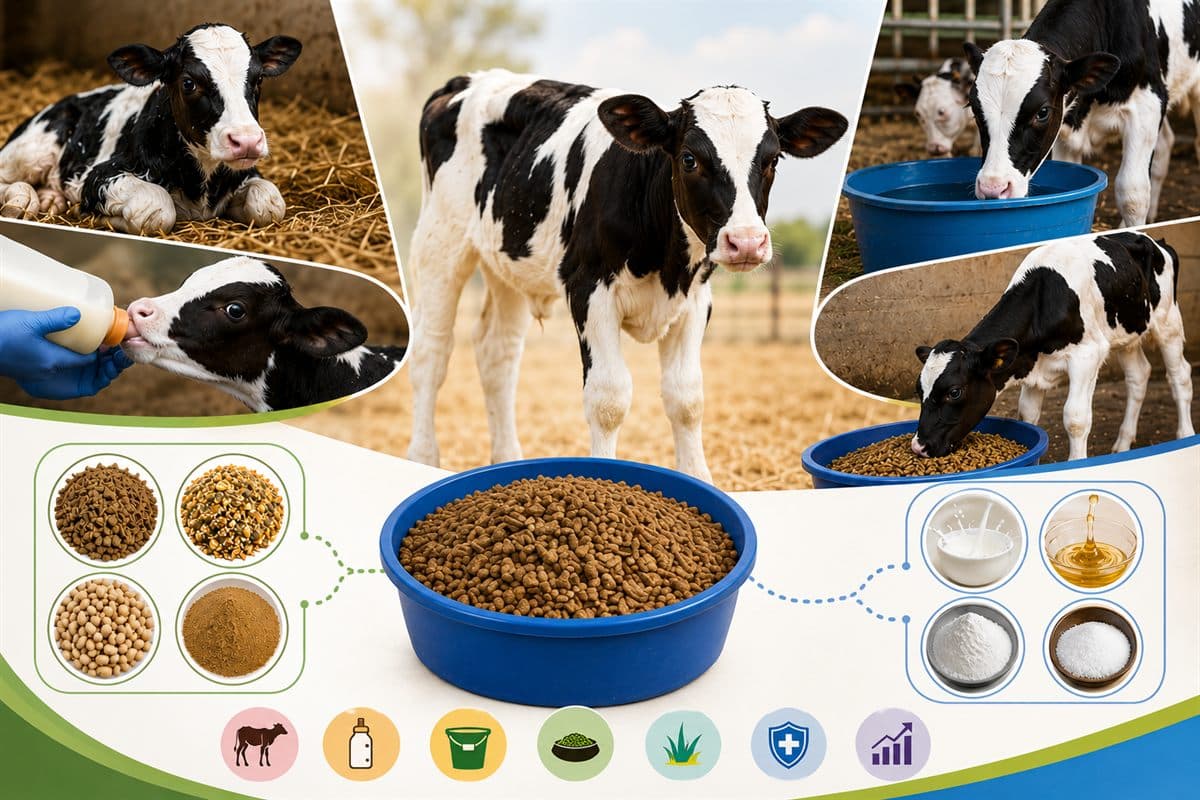
Calf Starter Feed: Complete Guide from Birth to Weaning
Calf starter feed in Indian dairy — colostrum, milk feeding schedule, BIS Type-1 specs, why no urea for calves, weaning age, and common mistakes.
Ketosis in Dairy Cattle: Causes, Detection & Prevention
Ketosis in Indian dairy cattle — clinical vs subclinical, BHB thresholds (1.2 / 3.0 mmol/L), BCS and transition-cow prevention, and treatment options.
Mastitis in Dairy Cattle: Prevention, Detection & Treatment
Mastitis in Indian dairy cattle — clinical vs subclinical, SCC thresholds, NMC 5-point prevention, dry cow therapy, treatment, and the economic cost.