Total Mixed Ration (TMR) for Dairy Cattle
By Parv Badjatiya · Published Mon May 18 2026 00:00:00 GMT+0000 (Coordinated Universal Time) · Updated Mon May 18 2026 00:00:00 GMT+0000 (Coordinated Universal Time)
What is TMR and why it matters
A Total Mixed Ration (TMR) is a feeding system in which all of an animal's daily nutrition — forages, concentrates, mineral mixture, salt, bypass fat, bypass protein, additives — is weighed, chopped, and mixed together into a single uniform ration. The animal then eats the same balanced bite every time, all day long. A properly formulated TMR hits target dry matter (DM), acid detergent fibre (ADF), neutral detergent fibre (NDF), and palatability values simultaneously — something separate-component feeding cannot reliably do.
In traditional Indian dairy feeding, animals receive green fodder, dry fodder, and concentrate as separate components at separate times. The animal selects the most palatable parts (often the molasses-coated concentrate first) and may leave less-preferred ingredients (chopped straw, less-loved fodder) under-eaten. The result is uneven nutrient intake, lower rumen pH spikes from concentrate slugs, and inefficient feed conversion.
TMR solves all three problems at once. Every kilogram of TMR contains the same protein, energy, fibre, mineral, and additive content. The animal cannot pick favourites because the favourites are physically blended into the disliked parts. Rumen pH stays steady because concentrate and fibre arrive together at every bite. Total dry matter intake typically rises by 5–15% vs separate feeding at the same nutritional formulation, and milk yield rises proportionally.
This article walks through how TMR works, how to formulate one for Indian dairy conditions, and the practical compromises that make TMR work even on smaller farms.
- Eliminates selective eating — every bite is the same nutrient profile
- Steady rumen pH (6.0–6.5 all day, vs sharp dips after concentrate slugs)
- 5–15% higher dry matter intake at the same formulation
- Proportional milk yield lift, especially in high-yielding herds
- Hides less-palatable ingredients (mineral mix, additives) into the mix
- Very small herds (1–3 animals) — mixer ROI doesn't pay back
- No mechanical mixer + no labour to mix by hand consistently
- Highly variable ingredient supply — TMR works best with steady inputs
- Animals at very different production stages mixed in one group
- No way to chop forage to 1–4 cm (the particle-size discipline TMR needs)
Why TMR improves milk production
Three mechanisms drive TMR's advantage:
1. Elimination of selective eating
In a traditional feeding system, a 500 kg lactating buffalo might be served 5 kg of concentrate at 6 AM, 25 kg of green fodder mid-morning, 4 kg of chopped straw afternoon, and another 5 kg of concentrate at 6 PM. The buffalo eats the concentrate aggressively (it's tasty), grazes through the fodder, and may leave 1–2 kg of the least-preferred straw uneaten daily.
In TMR, all 39 kg are pre-mixed. The animal cannot eat 5 kg of pure concentrate at one go — every bite is roughly 12% concentrate and 60% green fodder and 10% straw and 0.4% mineral mix and so on. Refusals drop to under 5% and the nutrient profile of what's eaten matches the formulation exactly.
2. Steady rumen pH
When an animal eats 5 kg of concentrate in a single 30-minute meal, rumen pH plunges to 5.5 or below within 90 minutes, suppressing fibre digestion and risking acidosis. When the same 5 kg is spread across 24 hours of TMR consumption, rumen pH stays comfortably at 6.0–6.5 throughout, fibre digestion runs at full efficiency, and the animal can handle higher total concentrate intake without acidosis.
3. Continuous nutrient flow
Microbial protein synthesis in the rumen requires steady supply of both fermentable energy (from grain starches) and degradable protein (from forages and protein meals). TMR maintains both flows continuously through the day, maximising microbial protein yield — which is then absorbed by the small intestine alongside any bypass protein included in the mix.
Components of a TMR
A typical Indian lactating dairy TMR is built from five categories of ingredients:
| Category | Function | Typical % of total ration (DM basis) |
|---|---|---|
| Forage — wet (green fodder, silage) | Bulk, fibre, vitamins, palatability | 30–45% |
| Forage — dry (chopped straw, hay) | Effective fibre, rumen scratch factor | 10–20% |
| Concentrate (compound feed or farm mix) | Energy, protein, minerals | 30–45% |
| Supplements (bypass protein, bypass fat, additives) | High-density nutrients for peak yield | 2–8% |
| Mineral mix + salt | Essential minerals | 1–2% |
The exact proportions depend on milk yield, animal type, and local ingredient availability. The principles below cover the universal rules.
Sample TMR for a 500 kg lactating buffalo
This is a representative TMR for a Murrah buffalo yielding 10 L/day of 6.5% fat milk in peak lactation. Quantities are as-fed (wet weight at feeding time).
| Ingredient | Wet weight (kg/day) | Approximate dry matter contribution |
|---|---|---|
| Maize silage (35% DM) | 15.0 | 5.25 kg DM |
| Green fodder (maize/jowar/lucerne, 20% DM) | 15.0 | 3.0 kg DM |
| Dry fodder (chopped wheat/paddy straw, 90% DM) | 4.0 | 3.6 kg DM |
| Compound cattle feed (Type-2 or Type-1, 89% DM) | 6.0 | 5.35 kg DM |
| Bypass protein | 0.5 | 0.44 kg DM |
| Bypass fat | 0.25 | 0.25 kg DM |
| Mineral mixture | 0.15 | 0.13 kg DM |
| Common salt | 0.05 | 0.05 kg DM |
| Total | ~40.95 kg as-fed | ~18 kg DM |
Approximate ration outcome on a DM basis:
- Crude protein: ~17%
- TDN: ~65–67%
- Fat (ether extract): ~5–6%
- DM intake: ~2.8% of body weight
- Total moisture in ration: ~56% (within target range)
This is a starting point. Adjust ingredient proportions for local ingredient availability, current prices (use the ration cost calculator), and the animal's actual production level.
The four critical TMR parameters
1. Moisture content: 45–55%
Below 40% moisture, the mix is too dry — animals sort the long forage from the fine concentrate and selectively eat the fines. Above 60%, the mix is too wet — animals fill on water and total dry matter intake drops, hurting milk yield.
Indian TMR usually targets 50–55% moisture, slightly higher than the Western standard, because Indian green fodder is typically more abundant and lower in dry matter than Western alfalfa hay. The moisture comes from green fodder and silage; if the mix runs dry, water can be added to the mixer in controlled quantities.
2. Particle size: forage chop length 1–4 cm
Long forage (above 4 cm) doesn't mix uniformly and creates pockets the animal can selectively pick around. Very short forage (below 1 cm) lacks the "scratch factor" that stimulates cudding and saliva production for rumen buffering.
The standard target: 1–4 cm chop length for the bulk of forage, with 5–15% of particles longer than 4 cm for effective fibre. A simple farm-level test is to grab a handful — if you see 5 long pieces in every handful, that's about right.
3. Mixing time and order
Standard order of loading into a TMR mixer (smallest-amount ingredients first):
- Mineral mixture, salt, additives
- Bypass protein, bypass fat
- Concentrate (compound feed)
- Dry fodder (straw)
- Silage
- Green fodder (last, on top)
Mix time: 3–5 minutes after the last ingredient is added. Over-mixing breaks down forage particles below 1 cm and reduces effective fibre. Under-mixing leaves pockets of concentrate the animal can sort and eat first.
4. Daily refusals: 3–5% of total offered
A well-formulated TMR will be eaten almost entirely. Aim for 3–5% refusal at the end of the day — this confirms the animal had unlimited intake without being so over-fed that waste rises. If refusals are 10%+, the formulation has too much of one ingredient or the mix is too dry. If refusals are zero, the animal might be intake-restricted (could eat more if offered).
TMR for Indian smallholder dairies: the partial TMR (MTMR) compromise
Full TMR with a mechanical TMR mixer wagon (typical capital cost ₹6–15 lakh) is hard to justify for herds under 25 animals. But the benefits of TMR — uniform bites, no sorting, steady rumen pH — can be achieved more cheaply for smaller herds through a Modified TMR (MTMR) approach:
- Chop all fodder to 1–4 cm using a manual or small-scale electric chopper
- Combine forage components (green fodder, silage, chopped straw) on a clean concrete feeding pad
- Spread concentrate evenly over the forage
- Mix by hand or with a digging tool for 2–3 minutes
- Offer to animals — the resulting mix is 80% of a full TMR's homogeneity
MTMR captures most of the milk-yield benefit of full TMR at fractional cost — only labour time and a manual chopper.
Why TMR is growing in Indian dairy
Three forces are driving TMR adoption in Indian commercial dairy operations:
- Larger herd sizes. Modern commercial dairies of 50, 100, 500+ animals find the TMR investment economic — labour saved per cow more than offsets the capital cost
- Higher-yielding genetics. Crossbred Holstein-Friesian × Indian dairy cattle and high-yield Murrah buffalo benefit disproportionately from TMR because they cannot meet their nutrient demand from separate feeding alone
- Quality milk premiums. Processors paying premium prices for high fat / high protein / low SCC milk reward the consistency that TMR delivers
Smallholder dairy (under 10 animals) is still dominated by traditional separate feeding, but MTMR is gaining ground there too.
Common TMR mistakes
| Mistake | Consequence |
|---|---|
| Mix too dry (under 40% moisture) | Sorting, selective eating, uneven nutrition |
| Mix too wet (>60% moisture) | Reduced dry matter intake, lower milk yield |
| Over-mixing | Forage particle size drops below 1 cm, rumen pH suffers |
| Loading order wrong (concentrate first) | Concentrate clumps at the bottom, animal eats it all at once |
| Skipping bypass supplements | High-yield animals run protein and energy deficits |
| Same TMR for high-yield and dry cows | Dry cows over-condition, high-yield cows under-nourished |
| Not testing refusals | Cannot detect formulation problems early |
Group feeding: one TMR per production group
Larger dairies that run multiple production groups (high-yield, mid-yield, dry cows, heifers, calves) typically run a different TMR for each group:
| Group | TMR characteristics |
|---|---|
| Fresh / high-yield (peak lactation, 100 days) | Highest energy and protein density, bypass fat + bypass protein, low-fibre forage |
| Mid-lactation | Moderate density, full mineral mix, balanced |
| Late lactation / pregnant | Lower density, higher fibre, less concentrate |
| Dry cows | Maintenance ration, more straw, less concentrate, no bypass supplements |
| Heifers | Growth-focused, moderate protein, good mineral support |
| Calves (after weaning) | Calf starter–based, higher protein, no urea, no glucosinolate-rich cakes |
Smaller operations use one or two TMRs only and accept the trade-off.
Cost comparison: TMR vs separate feeding
For a typical Indian commercial dairy of 50 lactating animals:
| Cost component | Separate feeding | TMR |
|---|---|---|
| Feed cost per kg DM | Same | Same |
| Refusal losses | 8–15% | 3–5% |
| Labour cost (multiple feedings) | High | Lower (one mix, one feed) |
| Equipment capital | None | TMR wagon (₹6–15 lakh) + chopper |
| Milk yield uplift | Baseline | +5–15% |
| Net effect | Higher refusal waste + labour | Lower refusals + equipment depreciation + more milk |
The payback period on a TMR wagon investment for a 50-animal dairy is typically 2–4 years through reduced refusals and improved milk yield alone.
Conclusion
Total Mixed Ration is the modern standard for commercial dairy feeding because it solves the three problems of traditional separate feeding at once — selective eating, rumen pH instability, and uneven nutrient flow. A properly formulated TMR delivers 5–15% more milk from the same feed inputs, simply through better nutrient delivery to the animal.
For Indian dairy, the practical guidance is: mid-to-large operations should adopt full TMR with a mechanical mixer; smallholders should adopt Modified TMR (MTMR) using manual mixing on a feeding pad. Either way, the four critical parameters (moisture 45–55%, particle size 1–4 cm, mixing 3–5 minutes, refusals 3–5%) determine whether the system actually delivers its potential. Done right, TMR is one of the highest-ROI management changes available to a modern Indian dairy.
Frequently asked questions
What is a Total Mixed Ration (TMR)?+
What is the difference between TMR and traditional separate feeding?+
What is the ideal moisture content of a TMR?+
Is TMR practical for Indian smallholder dairies?+
What is the right particle size for a TMR?+
What is a sample TMR for a lactating buffalo yielding 10 litres per day?+
Related articles
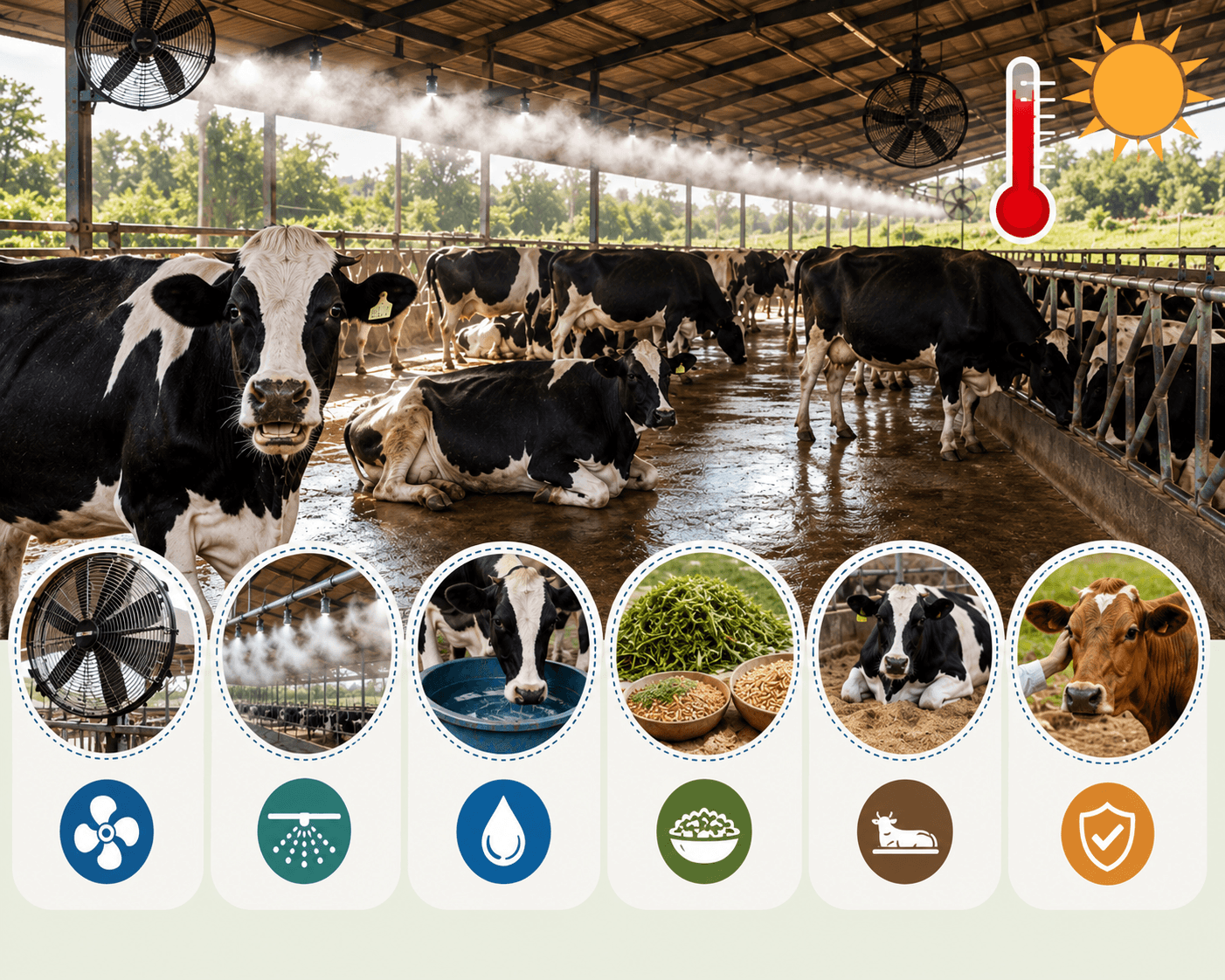
Heat Stress in Dairy Cattle: How to Manage Summer in India
Managing summer heat stress in Indian dairy cattle and buffalo — signs to watch, cooling methods (shade, fans, sprinklers), and keeping milk yield steady.
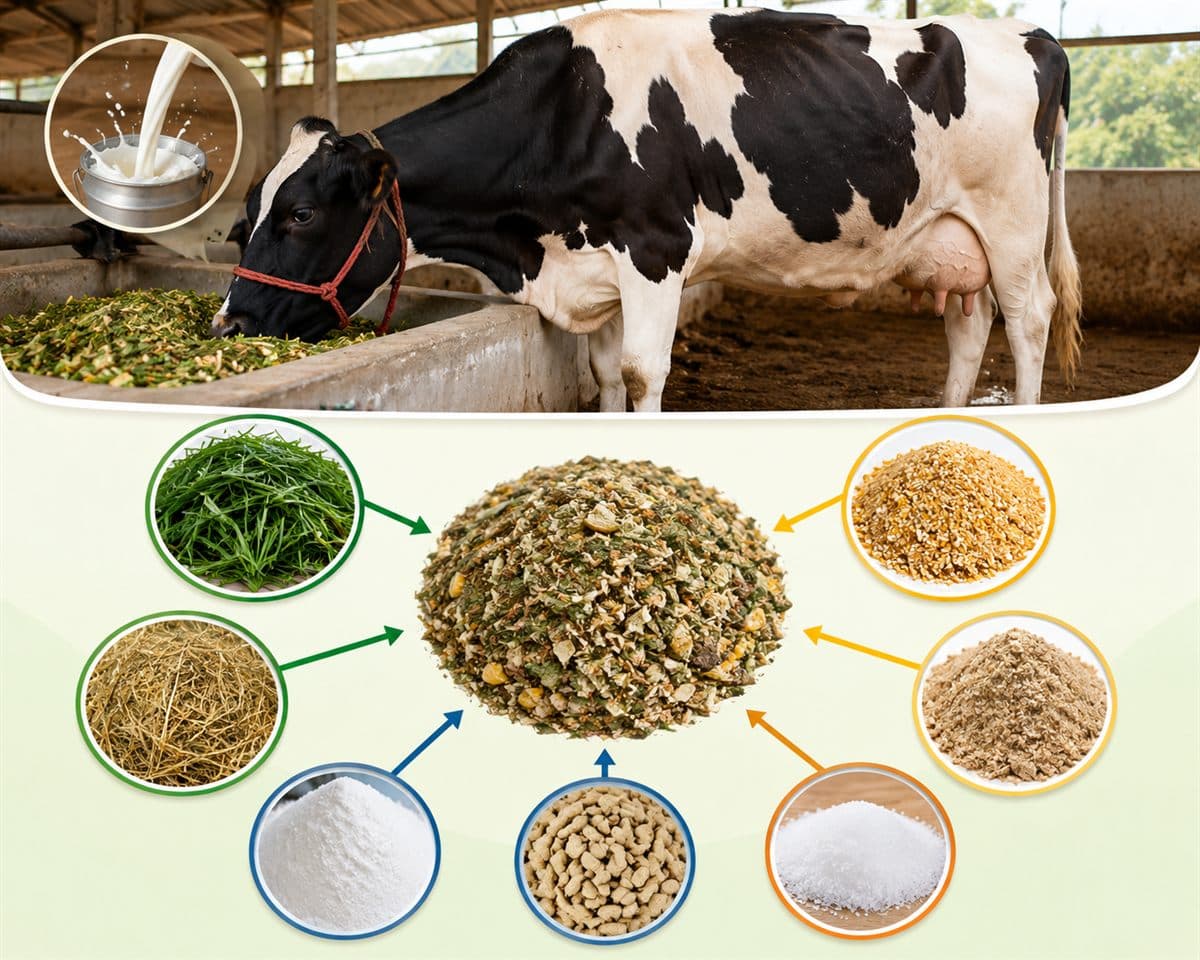
Feeding Lactating Cow: Complete Ration Guide
Feeding lactating dairy cows in India — Type-1 vs Type-2 compound feed by milk yield, sample rations, 21-day transition, and breed-specific notes.
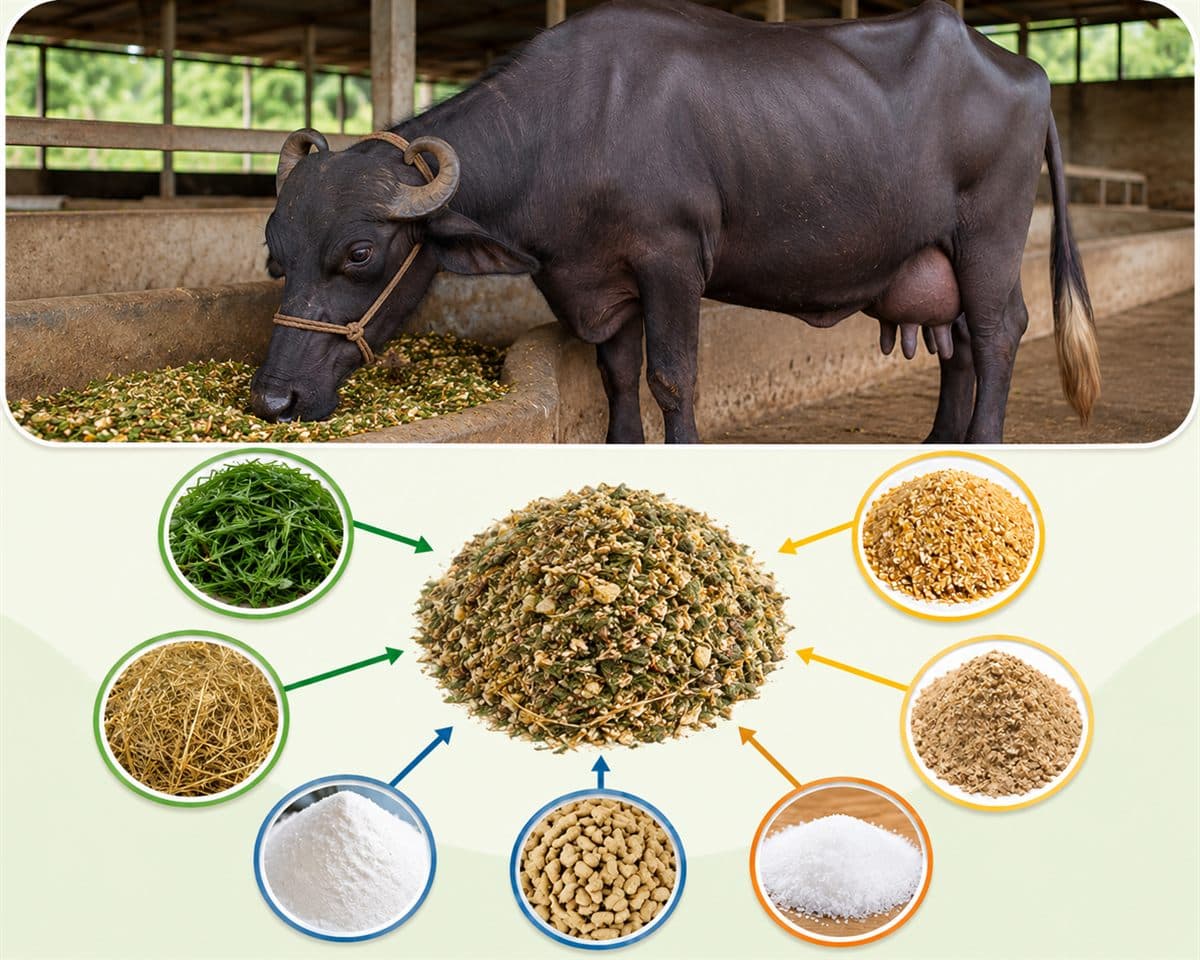
Feeding Lactating Buffalo: Complete Ration Guide
How to feed a lactating buffalo in India — DMI, energy and protein targets, fat advantage over cows, sample ration, and bypass fat use.